Last Saturday, a guy in my neighborhood pulled his NA Miata into the driveway with a shiny black bar behind the seats. He had paid $420 for the part, another $350 for installation, and still did not know whether his insurance company needed to hear about it. That is the part that gets people. You buy a Miata rollbar for protection or track-day preparation, then discover the bar affects seat travel, soft-top clearance, vehicle value, and possibly your policy.
I used to sell cars, not race them, so I am not going to pretend a bolt-in bar turns a street car into a competition car. It does not. But I can walk you through the money and the paperwork before you place an order. A Miata rollbar is a modification worth researching carefully, especially on an older car where one bad fit can cost more than the part itself.
What a Miata rollbar actually does
A rollbar is a structural safety component intended to provide some protection in a rollover. It is not the same thing as a roll cage. A cage adds multiple tubes around the cabin and is designed as a connected structure for more demanding motorsport use. A single bar behind the seats gives you less coverage and cannot eliminate injury risk.
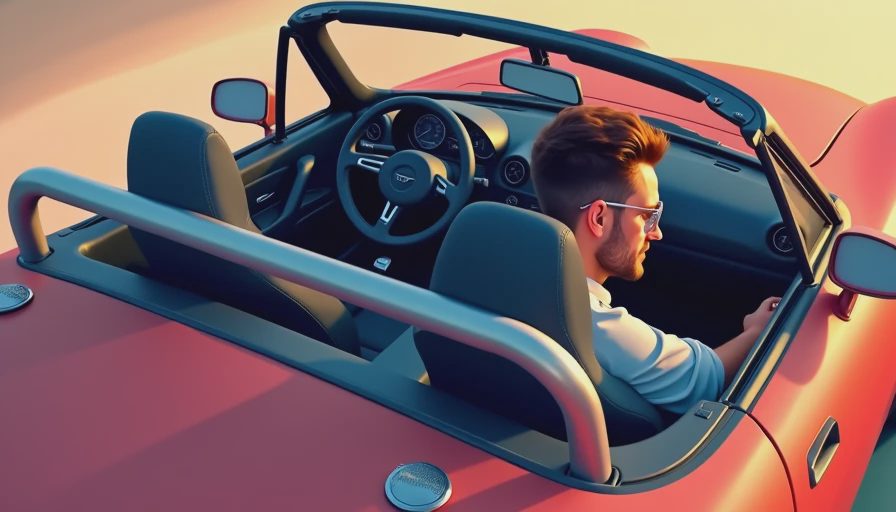
The design matters. A bar that mounts securely to the chassis is a different proposition from a decorative show bar attached to thin sheet metal. Look for installation instructions, mounting plates, material details, and compatibility with your exact generation. NA, NB, NC, and ND Miatas have different interiors, belt arrangements, roof designs, and mounting points.
You also need to think about your head. If your helmet or head can contact the bar during a crash, padding and bar placement become serious concerns. Some racing organizations specify padding, seat type, harnesses, and clearance. A street setup has different requirements, but the basic question remains: can you sit normally without being dangerously close to the tubing?
Choosing between bolt-in and weld-in designs
A bolt-in Miata rollbar is attractive because it can be installed without permanently welding the car. Typical parts run from roughly $350 to $900, depending on the manufacturer, finish, harness-bar options, and model year. Installation might add $250 to $700 if the interior comes out cleanly and the mounting points cooperate.
A weld-in bar can cost more because the shop must measure, remove trim, protect the interior, weld carefully, and repaint or seal the work. A realistic project total can reach $1,200 to $2,000. That price is not automatically wasteful. A properly engineered welded installation can be appropriate for a dedicated track car. It is a harder choice for a daily driver you might sell next year.
Before buying, ask whether the roof opens and closes with the bar installed. Check seatbelt operation, seatback adjustment, rear-window clearance, and access to the trunk. On a convertible, a part that looks perfect in an online photo can interfere with the top frame by half an inch. That half inch is your problem after the return window closes.
Ask the seller for the exact chassis year, not just “Miata compatible.” A bar listed for a 1990-1997 car may not fit a 1999-2005 car. Save the product page, order confirmation, and installation manual. Those documents help if the part arrives wrong and give your insurer a clear description of the modification.
The insurance question people skip
Call your insurer before installation and use plain language: “I am adding a Miata rollbar that costs about $700, and installation will cost another $400. How does my policy treat that modification?” Do not bury it under the phrase “safety equipment.” The company needs to know what changed and how much it would cost to replace.
Liability coverage generally protects you when you are legally responsible for injuries or property damage suffered by someone else. It does not pay to replace your own bar after a crash. Collision coverage is the part that typically applies to damage to your Miata from a collision, subject to your deductible and policy terms. Comprehensive coverage generally addresses non-collision events such as theft, hail, fire, or falling objects.
The important issue is whether the added equipment is covered under the policy’s standard vehicle value or requires custom-parts coverage. Some policies include a limited amount for aftermarket equipment, perhaps $500 or $1,500, while others require an endorsement. If your bar and installation total $1,100 but your limit is $500, the math is not complicated: $600 is exposed before you even discuss your deductible.
Progressive, GEICO, State Farm, and other major insurers handle modifications through their own underwriting rules and policy forms. I am not promising one company will approve or reject your setup. Get the answer in writing through your agent, online message center, or email. A phone promise from somebody who cannot find the modification on your policy is not a plan.
Track use changes the conversation
A Miata rollbar installed for autocross or a road course raises a second question: does your auto policy cover track use? Standard personal auto policies commonly exclude racing, timed events, and organized competition. Driving to the track is one thing. Taking timed laps is another. If you damage the car at an event, collision coverage may not respond.
Track-day insurance is a separate product offered by specialty providers for certain events and vehicles. The price can be a few hundred dollars for an event or more for broader coverage, depending on the car and limits. Read the exclusions. Some policies exclude damage caused by an improperly installed safety device, while others require approved harnesses, seats, or a particular type of Miata rollbar.
Your regular policy still matters for street driving. Tell the insurer how you use the car. “Weekend road trips and occasional track days” gives an underwriter useful information. “It is just a second car” does not answer the question if the car spends six weekends at a circuit every year.
Do the math before you modify the car
Start with the car’s real market value. A clean NB Miata might sell privately for $7,000 to $12,000 depending on condition, mileage, rust, and records. A $1,500 safety modification is a meaningful percentage of that value, but it may not increase the car’s book value by $1,500. Insurers usually pay based on the policy’s valuation method, not on every dollar you put into the vehicle.
Here is the driveway math. The bar costs $650. Shipping is $85. Installation is $475. New padding and replacement trim add $90. Your total is $1,300. If the insurer recognizes only $500 in aftermarket equipment and your collision deductible is $1,000, a serious claim can leave you paying the deductible plus much of the upgrade cost. That does not make the bar a bad purchase. It means you should buy it for the function, not because you expect the money to come back at resale.
If you sell the car, keep the original parts. Some buyers want a stock interior, especially if the bar reduces seat movement or prevents the factory top from folding normally. A reversible installation gives you more choices. Removing it later might cost another $200 to $500, and holes, worn trim, or damaged carpet can reduce what the next buyer offers.
A practical inspection checklist
Before you hand over your card, confirm five things. First, the product fits your exact Miata generation and seat configuration. Second, the mounting hardware and backing plates are included. Third, the bar does not block the factory seatbelts or create head clearance problems. Fourth, the installation shop has worked on convertibles and can show you how the bar attaches. Fifth, your insurer has documented the modification and the amount you want covered.
After installation, inspect every fastener after the first few drives. Look for loose trim, new rattles, roof interference, and seatbelt webbing that rubs against the bar. If the shop used a torque specification, ask for it on the invoice. Take photos of the installed bar, mounting points, and the car’s condition. Keep those photos with your receipt and policy documents.
A Miata rollbar can be a sensible upgrade, but buying the cheapest tube you find is not the same as making the car safer. Fit, engineering, installation, seating position, and insurance all belong in the same decision. Call your insurer before the box arrives, ask what aftermarket equipment limit applies, and get the answer documented. Then compare that number with your actual receipt. I told you what they told me to say. Now you know.

No letters yet — pray write the first.