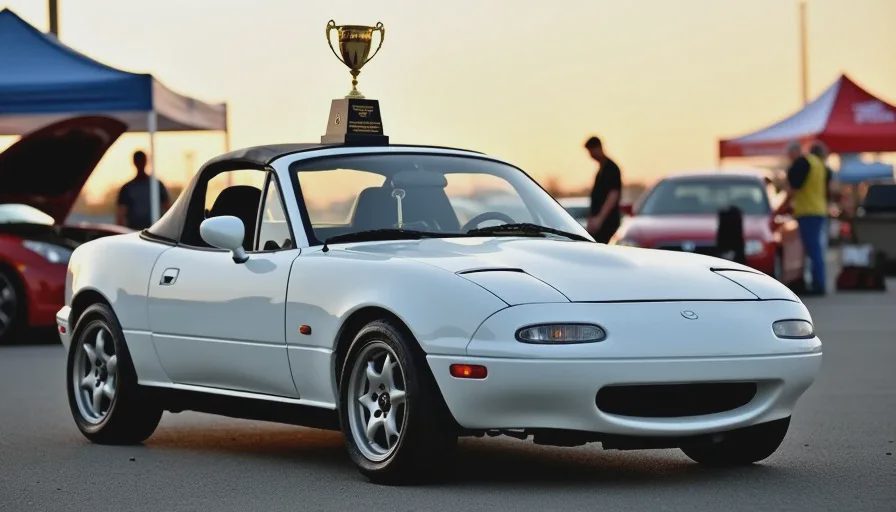
Last month, I won my class at an SCCA Time Trial event at Barber Motorsports Park. The trophy is on Jenn's bookshelf now, wedged between Lily's spelling bee medal and a framed photo of our wedding. When people ask about it, I tell them the truth: it was a light field that day. Two cars in my class. One of them broke. I took the top step of the podium because the other guy's radiator had other plans.
This is an honest SCCA Time Trial recap. Not the version where I pretend the win was inevitable. Not the version where I leave out the part about the Toyota Sienna that almost ended my weekend before it started. The real version. The one where winning feels complicated, and that's fine, because I didn't get into this sport for the trophies. I got into it for the 19-minute drive from my garage to the track, and the spreadsheet I keep of every lap I've ever turned, and the feeling of nailing Turn 14 exactly once per weekend and spending the rest of the month chasing it.
The Setup: Two Cars, One Trophy
The SCCA Time Trial program groups cars by power-to-weight ratio and modification level. My NA Miata, with its 1.8-liter engine and MCS coilovers and roll bar, runs in Sport 4. It's a competitive class — normally. On this particular Saturday, only two cars were registered in S4: my Miata and a Honda S2000 owned by a guy named Derek from Huntsville.
Derek and I have been trading lap times for two seasons. He's faster than me through Barber's back section. I'm faster through the tighter stuff. Our best laps are usually within half a second of each other. We've developed the kind of paddock friendship where you share tire pressure data and also make fun of each other's brake pad choices. He runs Carbotech. I run Hawk. We both think the other one is wrong.
We had three timed sessions scheduled: morning, midday, and afternoon. Best single lap time across all sessions determines the winner. Simple format. No wheel-to-wheel. Just you, the clock, and whatever mistakes you can't blame on traffic.
The Pre-Weekend Checklist I Actually Followed
I'm not going to pretend I have a rigorous pre-track routine. I don't have a trailer. I don't have a crew. I drive the Miata to the track with a duffel bag in the passenger seat containing:
Item | Purpose |
|---|---|
Torque wrench | Lug nuts, every session |
Tire pressure gauge | Cold and hot pressures |
1 quart of 10W-30 | The Miata burns a little oil at high RPM |
Folding chair | Paddock comfort |
Granola bars (3) | Breakfast, lunch, and the one I drop on the ground |
Sunscreen | Alabama in July |
Helmet and gloves | Required, also they make me feel serious |
I checked the oil. I torqued the lug nuts to 80 ft-lb. I set cold tire pressures to 26 psi all around, targeting 32–33 psi hot. I taped the wheel weights. I emptied the trunk of the random detritus that accumulates in a car without a radio — two water bottles, a sweatshirt, a socket that rolled under the spare tire in 2022 and has lived there ever since.
The car was ready. I was ready. Derek was ready. What could go wrong?
Session One: The Sienna Incident
Before I get to the timed sessions, I need to tell you about Friday evening. Because Friday evening was almost where my weekend ended.
I drove the Miata to the track around 5 PM for the optional practice and tech inspection. The car felt good. The weather was clear. I was mentally rehearsing my braking points for Turn 14. And then, at a stoplight on Highway 31, a silver Toyota Sienna rolled up behind me and stopped approximately eighteen inches from my rear bumper.
The driver was looking at her phone. I saw her in my rearview mirror — head down, thumbs moving, completely unaware that she was about to turn my Miata into an accordion. The light turned green. I didn't move immediately because I was watching her. She looked up, saw the green light, and started rolling forward before I did. She stopped about six inches from my bumper.
I pulled through the intersection, pulled into a gas station, and sat in the parking lot for five minutes breathing like a man who had just been reminded that a thirty-year-old roadster with no airbags is invisible to half the vehicles on the road. The Miata was fine. I was not fine for about fifteen minutes. Then I drove to the track anyway, because the alternative was going home and explaining to Max why Daddy's car almost got squished by a minivan, and I didn't have the words for that conversation.
If you drive your track car to the track — and I know many of you do — you already know this feeling. The most dangerous part of a track weekend is not the 100-mph corner. It's the drive to the track, where you're surrounded by people who are checking Instagram and eating breakfast burritos and treating their two-ton SUVs like mobile living rooms while you're sitting in a car the size of a well-packed suitcase. Drive defensively. Assume you're invisible. Keep your head on a swivel.
Session Two: The Lap That Counted
Saturday morning. 9:15 AM. Track temperature was about 80 degrees, ambient around 72. Perfect conditions. The Miata's tires — Toyo R888Rs with maybe four track days on them — were scrubbed in but still had plenty of life. I'd bedded in a fresh set of Hawk HP+ pads the week before, and the brake pedal felt firm.
I went out for the morning timed session with a simple plan: put down a clean lap early, post a time Derek would have to chase, and use the later sessions for experimentation. Turn 14 — my nemesis corner, the one I've written about before — was the focus. If I could get through 14 cleanly, the rest of the lap would take care of itself.
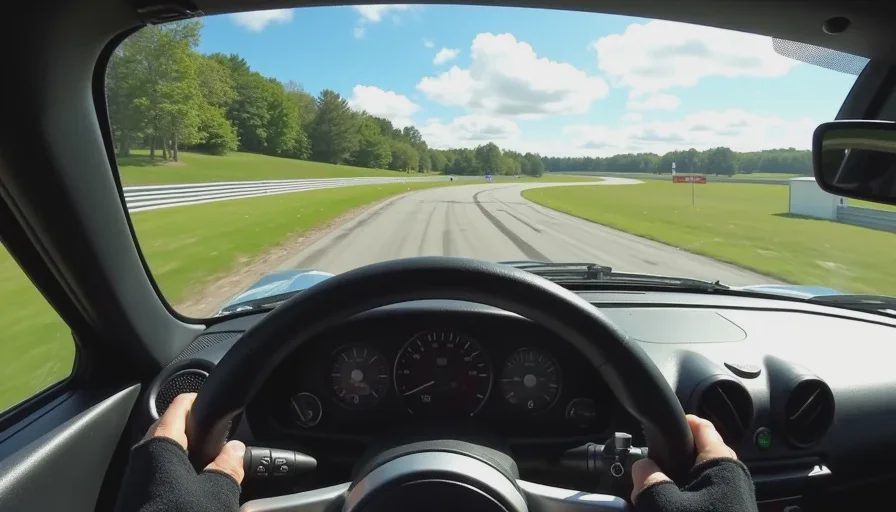
I won't walk you through every corner. But here's the key moment: Turn 14, third lap. I'd been building speed gradually. Lap one was a warm-up — tires and brakes coming up to temperature. Lap two was a 1:43.8, which is decent for this car but not competitive. Lap three, I told myself to brake five feet later into 14 and trust the car's rotation.
I braked later. The car rotated. I got back to throttle earlier than I usually do. The exit speed — measured by my Solo 2 DL — was 51 mph, which is the fastest I've ever carried out of that corner. The rest of the lap was clean. No traffic. No mistakes. The timer clicked off at 1:42.4.
I'm not going to pretend that's a heroic lap time. In the grand scheme of things, 1:42.4 around Barber in an NA Miata is respectable but not remarkable. But it was my best lap by three-tenths, and it held up through the rest of the morning session. Derek's best was a 1:43.1 — close, but behind.
In the paddock after the session, Derek walked over and asked what I'd done differently through 14. I told him about braking later and trusting the rotation. He nodded and said he'd been braking too early all morning. "I'll get you in the next session," he said. He probably would have.
Session Three: The Radiator That Changed Everything
The midday session started at 12:30 PM. Track temperature was now in the mid-90s. The Miata doesn't have an oil cooler, so I was watching my oil temps carefully — anything above 260°F and I back off. Derek's S2000, being a Honda, was built to handle heat better than my thirty-year-old Mazda.
We lined up in the hot pit. Derek's car sounded normal — that distinct F20C snarl that makes S2000s sound like they're doing 9,000 RPM even when they're idling. We went out, took our warm-up lap, and started building speed.
On the second hot lap, I noticed Derek slowing down. Not gradually — abruptly. He pulled off-line, raised a hand out the window to signal he was exiting the track, and limped into the paddock access road. I could see steam escaping from under his hood as he rolled past the flag station.
I finished the session, but my head wasn't in it. I posted a 1:43.0 — slower than my morning time, which was fine, because the morning time still stood. But I kept thinking about Derek's car. A DNF doesn't feel like a win. It feels like unfinished business.
What Happened to Derek's S2000
After the session, I found Derek in the paddock with his hood up. A small crack had developed in the plastic end tank of his radiator — a known weak point on AP1 S2000s, especially ones that see track time. The crack was small enough that it only opened up under full coolant pressure at high RPM. On the street, the car would have been fine. On the track, pushing 8,500 RPM in the Alabama heat, it was enough to spray a fine mist of coolant across the engine bay.
Derek was philosophical about it. "That's racing," he said, which is what people say when they're disappointed but don't want to show it. He'd driven down from Huntsville — about two hours — and paid the same entry fee I did. His weekend was over because a piece of twenty-year-old plastic gave up. Mine continued because my Miata's radiator was replaced three years ago as preventative maintenance. That's not skill. That's luck, disguised as preparation.
The afternoon session ran without Derek. I used it to experiment with different lines through Turns 2 and 3, because with nobody else in my class, there was no pressure. I posted a 1:44.1 — slow, but I learned something about Turn 3 that I think will pay off next time. I also spun at Turn 11, which was embarrassing but harmless. The corner worker gave me a thumbs-up. I gave one back. The Miata and I have an understanding about spins at this point.
The Podium (Such As It Was)
The SCCA Time Trial awards are informal — no champagne, no national anthem, just a volunteer handing out trophies in the pavilion while people pack up their trailers. I collected my trophy, shook Derek's hand, and told him I'd rather have beaten him on track than won by default. He said, "Next time." He meant it. I believe him.

Here's the thing about amateur motorsport: sometimes you win because you're fast. Sometimes you win because you're the only one who didn't break. Both count the same on the results sheet. But they don't feel the same in the paddock. I've been on both sides of this equation — I've had my own DNFs, my own mechanical failures, my own weekends that ended before they started. When you win because the other guy broke, you don't feel proud. You feel lucky. And then you go home and torque your radiator hoses and check your end tanks for cracks, because next time it might be your car steaming in the paddock.
What I Learned (Besides the Obvious)
Preventative maintenance is invisible performance. You don't get lap time credit for replacing your radiator before it fails. Nobody puts "new cooling system" on a mod list with pride. But the car that finishes is the car that wins, and the car that finishes is the car you maintained when nothing was wrong.
Take the lap early. My morning time stood up because I pushed for a clean lap in the first session. If I'd waited until the afternoon to go for a fast time — treating the morning as "practice" — a cloud could have moved in, the track could have gotten hotter, or any number of variables could have changed. Set a time while the conditions are good. You can always improve on it later.
There's no shame in a light field. I won because only two cars showed up. I won because one of them broke. I still won. The trophy doesn't have an asterisk. The SCCA results page lists my name first. In ten years, I'm not going to remember the details — I'm going to remember that I stood on the top step one time. That counts for something, even if I'm still chasing the win that actually feels earned.
The Real Trophy
I'm not being falsely modest when I say the trophy isn't the point. I've been doing track days and time trials for six years now. I've won exactly once, and it took Derek's radiator giving up to make it happen. If trophies were the point, I would have quit four years ago.
The point is Barber Motorsports Park at 9 AM on a Saturday, when the sun is still low and the track is cool and nobody else is around except the corner workers and a few early risers in the paddock. The point is the spreadsheet I update after every event with my lap times and my notes — "braked too early into 14, exit speed 49 mph, fix this." The point is the 19-minute drive from my garage to the track, windows down because the Miata doesn't have air conditioning, the smell of hot oil and cut grass, the anticipation of a corner I've taken 400 times and still haven't mastered.
I beat one guy and his car broke. That's the honest recap. It's not a story I'm going to tell Lily and Max when they're old enough to understand what a trophy means. But it's the story I'm telling you, because I promised when I started this blog that I'd tell the truth about what it's like to live with these cars — the wins and the losses and the weird, complicated ones that are both.
Derek and I are both registered for the next event in six weeks. His S2000 has a new aluminum radiator — he upgraded to a Koyorad, which he told me about in a text that included the words "never again" and a photo of the cracked end tank. He's going to be fast. I'm going to be ready. And if I beat him on pace, not on luck, that's going to feel a lot better than the trophy on Jenn's bookshelf.
But the trophy is still there. And when Max asks about it — which he will, eventually — I'm going to tell him the truth. "I beat one guy, and his car broke. And that's why you always check your radiator before track day."
What's your most complicated win? The one that counted but didn't feel the way you thought it would? Reply and tell me. I'm collecting stories about the gap between the results sheet and the real thing.

No letters yet — pray write the first.