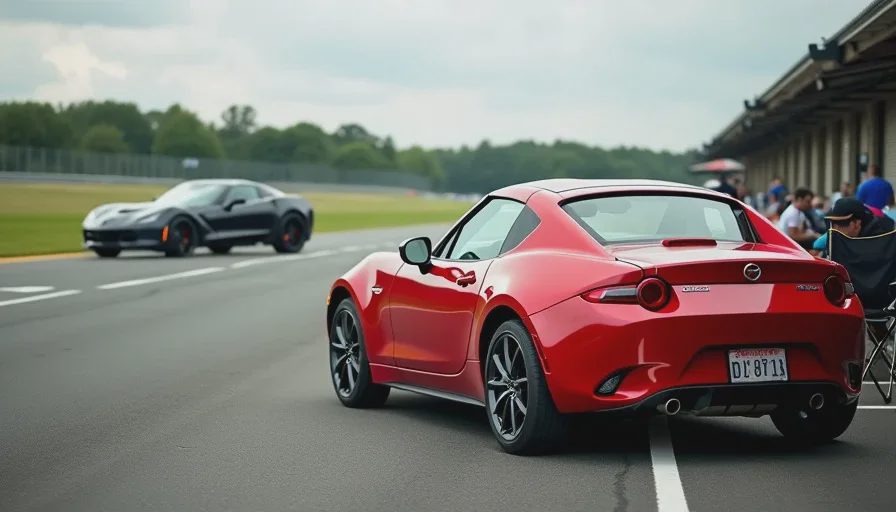
I spent three years trying to make my Miata faster. Stiffer springs, stickier tires, a header that cost me a Saturday and three stripped bolts. Every off-season, I'd scroll through forums and classifieds, pricing turbo kits and engine swaps, convinced that the gap between me and the podium was mechanical. It wasn't. The gap was between my ears. Chasing a faster car made me miserable and slow. Chasing consistency made me faster than I ever thought I could be. Here's how I figured that out, and why I'm done hunting for horsepower.
The Horsepower Trap
Two years ago at Barber, I got passed by a Corvette C7 Z06 on the front straight. It wasn't a battle — it was an execution. He motored by me with the casual brutality of 650 horsepower, and by the time we reached Turn 1, he was a dot on the horizon. I spent the rest of that session angry. Not at him, but at my car. My 128-horsepower, naturally aspirated, no-torque-below-4,000-rpm Miata. That night, I started a spreadsheet — because that's what I do — and priced out a Flyin' Miata turbo kit. $5,200 for the kit, another $1,500 for a clutch that could hold the power, plus a stand-alone ECU and tuning time with Reg. I was looking at $8,000 and a winter of work to maybe hit 200 horsepower at the wheels. I almost pulled the trigger.
The Lap Time That Stopped Me
The next track day, I ran a 1:42.8 at Barber — my personal best at the time — and I was still furious. I'd gotten held up in traffic, missed an apex by a foot, and over-slowed for Turn 14 again. On the cool-down lap, I glanced at the lap timer and realized something: my best lap of the day was only four-tenths faster than the same car, same setup, same driver six months earlier. I'd been obsessing over horsepower, but horsepower wasn't my bottleneck. Consistency was. The C7 driver? He ran a 1:36 and then spun at Turn 5 in the next session trying to chase a 1:35. I didn't spin. I just slowly, stubbornly, shaved tenths off my line.
The Consistency Epiphany
I called Reg the next day and told him I was thinking about a turbo. He listened for about ten seconds and then said, "Data first. Parts second." Classic Reg. Five words, all correct. So I did something radical for a guy who likes spreadsheets: I stopped looking at lap times for three months and only looked at sector deltas.
What the Data Told Me
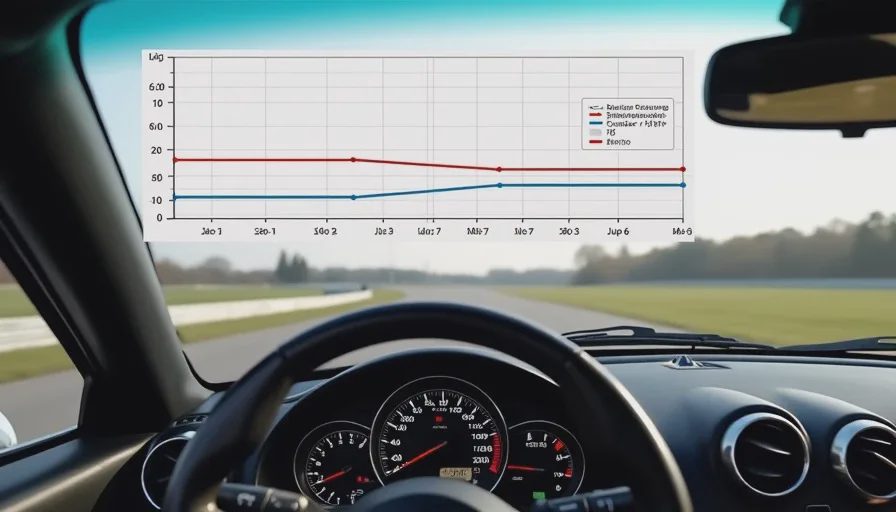
I pulled telemetry from my AIM Solo and overlaid ten laps from three different track days. The fastest laps weren't the ones where I carried the most speed through Turn 1. They were the laps where my minimum corner speed varied the least from lap to lap. On my best day, my minimum speed through Turn 2 deviated by less than 1.2 mph across five consecutive laps. On my worst day — the day I was angry about the Corvette — my variance was 4.7 mph. I was braking differently every single lap, chasing speed I hadn't earned, and my times showed it. The car was capable of a 1:41. My right foot wasn't.
The 1:41.2
Last November, I ran a 1:41.2 at Barber. No turbo. No engine swap. The same 1.8-liter that Mazda bolted together in 1994, still making somewhere around 115 horsepower at the wheels on a good day. The difference was that I'd stopped trying to go fast and started trying to not make mistakes. I braked at the same marker every lap. I turned in at the same point. I rolled onto the throttle at the same rate. By lap four, the car felt slow — that's the weird part. When you drive consistently, the speed hides from you. It only shows up on the timer. When I pulled into the paddock and saw 1:41.2 on the display, I thought the timer was broken. It wasn't. I'd just never given the car a chance to show me what it could do when I got out of its way.
What "Fast Enough" Actually Means
A faster car would mask my mistakes. More horsepower would let me recover lost time on the straights. Better aero would glue the car through corners I'm currently taking on faith and Toyo rubber. But masking mistakes isn't fixing them. The Miata exposes everything. If I brake five feet too late, the car pushes wide. If I get on the gas too early, the rear steps out. It's a car that punishes imprecision, and after four years of being punished, I've started to learn. A turbo would let me outrun a C7 on the straight. I'd rather out-brake him into Turn 1 because I know exactly where my pedal engages and he's still guessing.
Reg's Rule
Reg has a saying, one he's repeated often enough that I should stitch it on a pillow: "Horsepower hides the driver. Momentum reveals him." He means that a momentum car — a Miata, an old Civic, a BRZ — forces you to preserve every bit of speed you carry into a corner. There's no torque to bail you out. If you mess up the entry, the exit is already ruined. That's not a limitation. That's a teacher.
The Garage, Not the Catalog
I've stopped browsing turbo kits. Instead, I'm spending my budget on seat time and coaching. For the $8,000 I would have dropped on forced induction, I can do two years of SCCA weekends, tires, brake pads, and a data coaching session with a pro driver I met through the Barber paddock. I'm not building a race car. I'm building a driver. The Miata is fast enough. I just need to catch up.
Last week, Max asked me if our car could beat a Lamborghini. I told him probably not in a straight line. "But in the corners?" he asked. In the corners, buddy, I think we'd have a chance. He seemed satisfied with that. So am I. What's the one upgrade you thought you needed but later realized you didn't? I want to hear about it in the comments.




No letters yet — pray write the first.