Last Saturday, a guy in my neighborhood pulled into the driveway with a clean 2020 Mustang and a camera bag full of lenses. He had spent ten minutes photographing the car and still did not have one picture he liked. The problem was not the Mustang. It was that he had brought a lens suited for portraits and stood too close to the fender. If you are looking for the best lens for car photography, start with distance, perspective, and the kind of picture you actually want to make.
You do not need a $2,000 lens to photograph a car well. You need a focal length that lets you control reflections without bending the body lines. A useful lens gives you room to walk, keeps the grille from looking oversized, and shows the car as it sits rather than as a distorted toy.
The best all-around choice: a 24-70mm zoom
For most owners, the best lens for car photography is a 24-70mm zoom on a full-frame camera. On an APS-C camera, a 16-50mm or 17-55mm lens gives you a similar working range. This is the lens you take when you are photographing a car at a dealership, on a road trip, or in a driveway and do not know what space will be available.
At 24mm, you can fit a whole vehicle into a tight parking area. At 50mm, the proportions start to look more natural. At 70mm, you can compress the background and make a vehicle appear more planted against a line of trees, a garage, or a city street. That flexibility matters more than bragging rights about aperture.
A Canon RF 24-70mm f/2.8L, Sony FE 24-70mm f/2.8 GM, or Nikon Z 24-70mm f/2.8 is excellent if you earn money from photography. Those lenses can cost roughly $1,800 to $2,400 new. A Tamron 28-75mm f/2.8 or Sigma 24-70mm f/2.8 often delivers the practical result for less, commonly around $700 to $1,100 depending on the mount and sale price.
Why a 35mm or 50mm prime can be smarter
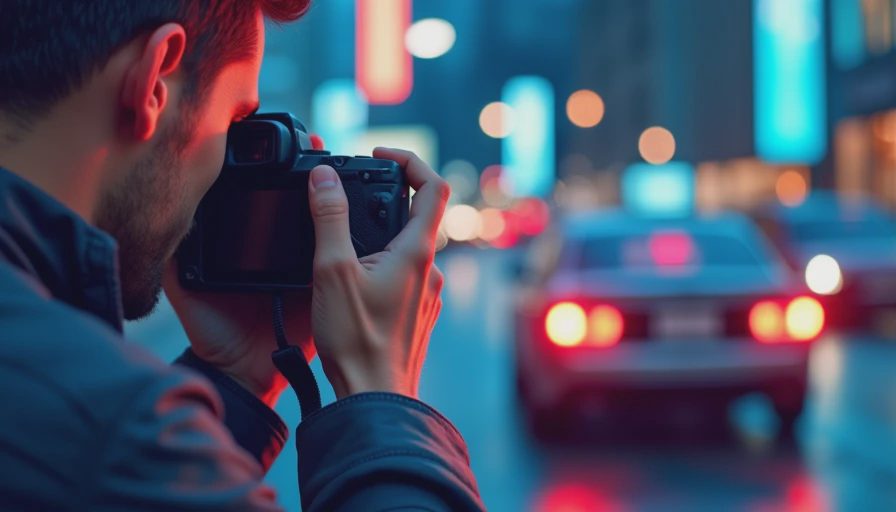
The best lens for car photography does not have to zoom. A 35mm prime on a full-frame camera is a strong choice for garage scenes, rolling shots from a safe distance, and photos that include the driver, tools, or location. It shows enough of the surroundings without making the car look stretched at the edges.
A 50mm prime is better when you have room to step backward. It produces a calmer, more natural perspective for three-quarter front views, side profiles, and interior details. A basic Canon 50mm f/1.8, Nikon 50mm f/1.8, or Sony 50mm f/1.8 may cost about $180 to $300. That is a lot less than replacing a bad photo shoot with another expensive one.
The tradeoff is simple. You have to move your feet. If a wall is behind you, a 50mm lens can become frustrating. If you are standing in an open lot, it can produce cleaner body lines than an ultra-wide lens.
When a wide-angle lens helps, and when it hurts
A 16-35mm lens has a place in car photography, especially for interiors, tight garages, dramatic low-angle shots, and vehicles surrounded by a large landscape. The wide view can show a Jeep on a trail or a truck in front of a barn without cutting off the environment.
But wide angle is where beginners get fooled. Put the camera two feet from the front bumper at 16mm, and the grille grows while the rear quarter panel shrinks. The vehicle may look aggressive, but it will not look accurate. That effect can be useful for an advertisement or a poster. It is usually a poor choice for a clean listing photo.
If you use the best lens for car photography in a wide range, keep the camera level and place the car near the center of the frame. Do not let important body lines sit near the corners unless you deliberately want that stretched look.
The telephoto option for rolling shots and details
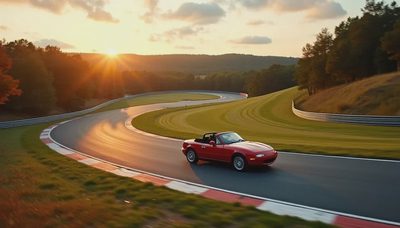
A 70-200mm lens is not the first lens I would buy, but it earns its place for certain jobs. From a safe roadside position, a 70-200mm can isolate a moving car from a messy background. It also works for badges, wheels, headlights, exhaust tips, and close details where you want the background softened.
A 70-200mm f/2.8 can cost $1,500 to $2,800. An f/4 version is lighter and often several hundred dollars cheaper. For a hobbyist, a 70-300mm zoom can be enough. You do not need to stand in traffic for a rolling shot. Use a second vehicle, a legal pull-off, and a driver who understands the plan. The picture is not worth a wreck.
Telephoto compression also changes the scene. A road can look closer to the car, and a background can appear larger than it did in person. That is a creative tool, not a defect, but use it knowingly.
Match the lens to the camera sensor
Before buying the best lens for car photography, check whether your camera is full frame or APS-C. A 35mm lens on a Canon crop-sensor camera behaves more like a 56mm lens in terms of field of view. A 50mm lens behaves closer to 80mm. That is not a problem, but it changes how much room you need.
For full frame, 24-70mm is the safe starting range. For APS-C, look at 16-50mm, 17-55mm, or 18-55mm options. Micro Four Thirds cameras can use a 12-35mm lens for a similar practical range. The printed focal length is only part of the story; the sensor determines how much of the scene fits in the frame.
Image stabilization helps when the car is parked and the light is fading. It does not freeze a moving car. For motion, shutter speed matters more. Start around 1/500 second for a sharp passing car, then experiment with 1/60 to 1/125 second if you want background streaks and spinning wheels.
A simple setup that saves you from bad reflections
A good lens cannot fix a chaotic reflection. Wash the car, move it out of direct overhead sun, and look at the paint before taking a picture. A large white wall, bright sky, or nearby garage door may appear across the hood and doors. Walk around the car and find the angle where the reflection follows the shape instead of cutting across it.
Keep the camera around headlight height for a natural view. Lower the camera slightly for a stronger stance, but do not point an ultra-wide lens upward unless you want the roof and hood to exaggerate. Shoot at f/5.6 to f/8 for a full-car image when light allows. Those settings usually give you enough depth of field to keep the front and rear of the vehicle sharp.
For interiors, use a tripod if possible and expose for the windows rather than letting them turn white. For paint details, move closer with a normal or short telephoto lens instead of pushing a wide lens into the panel.
The buying decision in plain dollars
If you own an entry-level camera, start with the kit zoom you already have. Learn where 35mm, 50mm, and 70mm look best before spending $1,000. If you want one upgrade, a used 24-70mm equivalent is the most flexible choice. If your budget is under $300, a 50mm f/1.8 prime gives you sharpness and a reason to think about composition.
The best lens for car photography is the one that fits your space, camera, and shooting habits. A $250 prime used carefully can beat a $2,000 zoom aimed at a shiny hood in harsh noon sunlight. Before you buy, take your current lens outside, photograph the car at several distances, and write down which focal lengths produce straight body lines. Then shop for that range, not for the biggest number on the box.
Next time you photograph a car, start at 50mm, step back until the whole vehicle fits, and check the reflections before touching the shutter. That three-minute test will tell you more than a sales pitch. I told you what they told me to say. Now you know.
No letters yet — pray write the first.