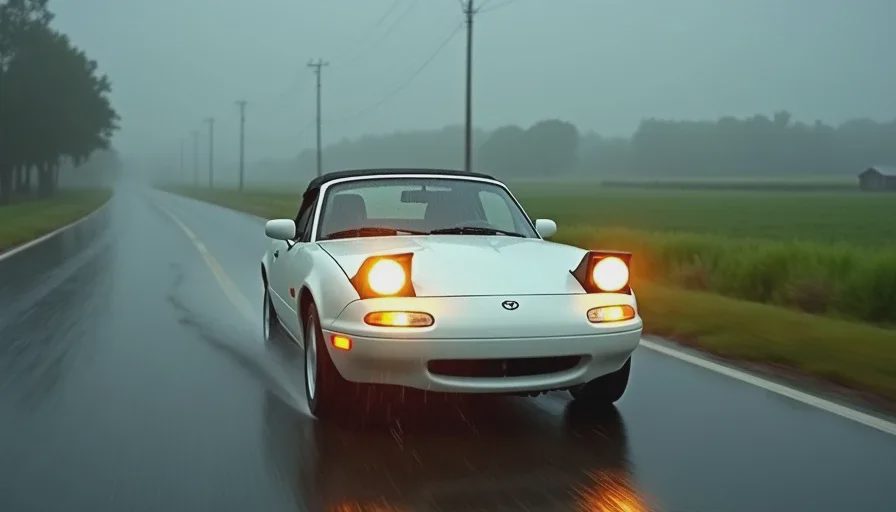
I drove the Miata home from Barber in a thunderstorm last August. Not a light shower — a genuine Alabama summer thunderstorm, the kind where the sky turns green-gray and the rain comes sideways and the weather radio interrupts every song on the FM band with a tone that sounds like the end of the world. I had no roof. I had no traction control. I had no ABS. I had a pair of Toyo R888R tires that are about as effective in standing water as a set of plastic cafeteria trays. And I had exactly 19 minutes to get from the track to my garage before the worst of it hit.
I made it home. The car is fine. But the drive changed something about how I think about risk — not just in cars, but in the larger, more complicated sense that involves a mortgage and two kids and a wife who would prefer I not die in a thirty-year-old Mazda with no airbags. This is the story of the last time I drove the Miata in the rain. It's also the story of why I'll do it again.
The Forecast I Ignored
Track days at Barber in August follow a predictable rhythm. Morning sessions are glorious — cool air, clear skies, a track surface that hasn't yet absorbed the full weight of the Alabama sun. By noon, the heat is building. By 2 PM, the pavement is hot enough to fry an egg and the humidity is somewhere between "oppressive" and "please let me die." By 4 PM, there's a roughly 40% chance of a thunderstorm that will appear out of nowhere, dump an inch of rain in twenty minutes, and then vanish, leaving behind nothing but steam rising off the asphalt and a bunch of track day participants staring at weather radar on their phones.
I knew this. I've lived in Alabama for more than a decade. August thunderstorms are not a surprise. They're a calendar event, like Christmas but wetter. And yet, when I left for the track that morning, I looked at the sky, looked at the weather app on my phone — 30% chance of isolated thunderstorms after 4 PM — and decided I'd be home by 3:30. Easy. No problem.
The afternoon session ran long. I was chasing lap times, trying to break into the 1:41s, and I kept telling myself "one more session." At 3:45 PM, I was still in the paddock, loading my gear into the passenger seat, when I heard the first rumble of thunder to the west.
The Equipment Problem
Let's talk about what a 1994 NA Miata is and is not equipped to handle in wet conditions.
System | What I Have | What I Don't Have |
|---|---|---|
Traction control | My right foot | Electronic intervention of any kind |
ABS | My right foot, again | Anti-lock brakes |
Tires | Toyo R888R, 200tw | Anything with tread depth suitable for standing water |
Roof | A Robbins soft top that lives in the "down" position | The will to put it up |
Windshield wipers | Yes, two speeds | Intermittent setting that actually works |
Defroster | The heater on full blast | A functional defroster that doesn't just make things foggier |
Driver assistance | My eyes and ears | Blind spot monitoring, lane departure warning, or any system invented after 1995 |
The R888R is the critical variable here. It's a 200-treadwear tire designed for dry track use. In the dry, it's predictable and communicative — it talks to you before it lets go. In the wet, especially in standing water, it's a different animal entirely. The tread pattern is essentially cosmetic. At highway speeds on a saturated road, the tire is less "gripping" and more "suggesting." You don't drive an R888R in the rain. You negotiate with it.
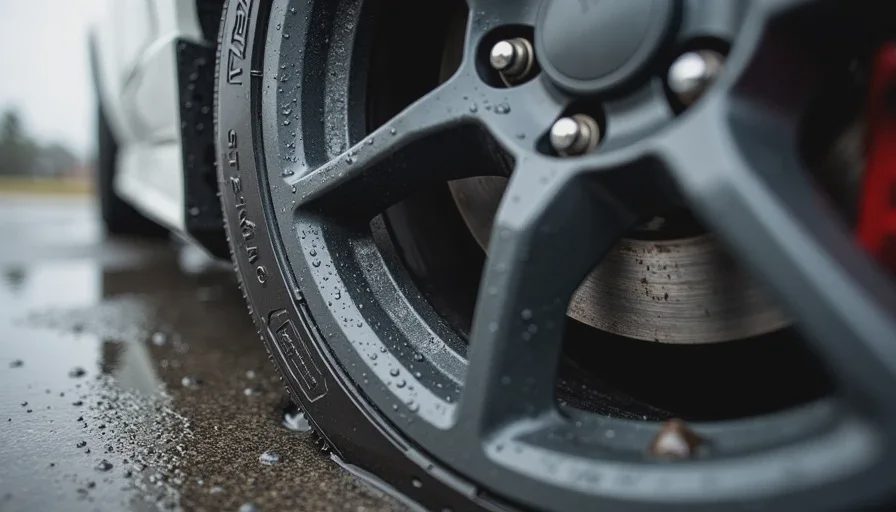
I knew all of this when I strapped into the driver's seat and turned the key. The thunder was closer now. The first fat raindrops were starting to dot the windshield. I had a decision to make: wait it out in the paddock, or try to beat the storm home.
I chose wrong.
The Drive: 19 Minutes That Felt Like an Hour
The first five minutes were fine. Light rain, wet roads but no standing water, the Miata tracking straight and true at 55 mph. I told myself the storm was moving slower than I'd thought. I told myself I'd be home before it got bad. I was wrong on both counts.
Mile 4: The Downpour Begins
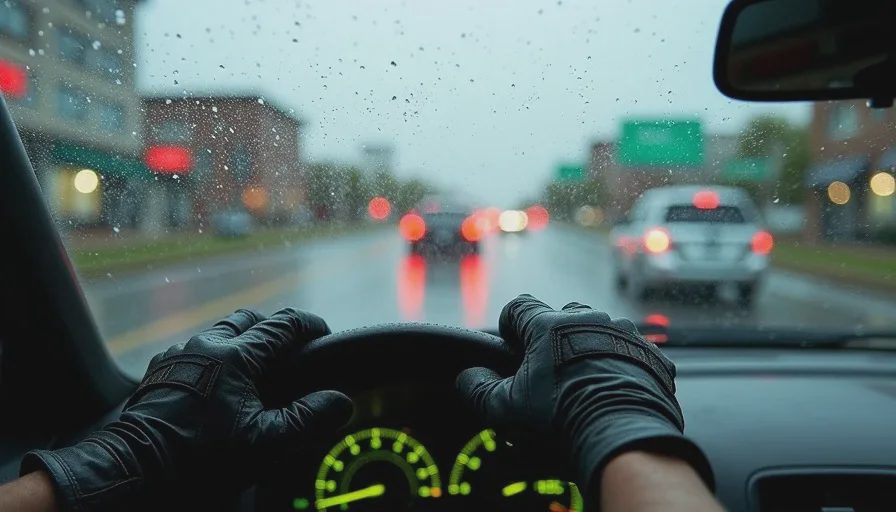
Highway 119, just past the entrance to Oak Mountain State Park. The rain went from "light" to "biblical" in the span of about thirty seconds. Visibility dropped to maybe 200 feet. The Miata's windshield wipers, which had been doing a perfectly adequate job in light rain, suddenly looked like they were waving at the water rather than clearing it. I slowed to 40 mph. Cars around me — sensible cars with roofs and all-season tires and electronic stability control — slowed to 45 and kept going. I was the slowest thing on the road, a white speck in a gray world, and I was acutely aware that the only thing between me and a very bad day was a set of tires that would rather be anywhere else.
Here's what driving an NA Miata in a thunderstorm feels like, mechanically speaking:
Steering goes light. The front tires aren't cutting through the water; they're riding on top of it. The steering wheel, which in the dry communicates every ripple in the pavement, goes vague and floaty. You can still steer, but the feedback is muted, like the car is talking to you through a pillow.
Braking distances triple. Without ABS, threshold braking in the wet is an exercise in terror management. Too much pedal, and the front wheels lock. Too little, and you're not slowing down fast enough. The R888R's wet braking performance is best described as "theoretical."
The rear end has opinions. Any application of throttle mid-corner sends the rear tires a message they interpret as "we'd like to lead now, please." The Miata's short wheelbase — one of its greatest assets in the dry — makes it snappy in the wet. Oversteer arrives without warning and departs just as abruptly, assuming you don't panic and lift completely off the throttle, which is exactly what your brain wants you to do.
Mile 8: The Hydroplane
Lakeshore Drive, crossing the bridge over the Cahaba River. There's a dip in the road just before the bridge, and water had pooled there — not a lot, maybe an inch deep, but enough. I hit it at about 35 mph. The steering wheel went completely light for what felt like a full second but was probably half that. The engine note climbed slightly as the driven rear wheels lost contact with the pavement. I did the only thing you can do in a hydroplane: nothing. No steering input. No brake. No throttle. Just hands at 9 and 3, eyes forward, waiting for the tires to find pavement again.
They did. The car settled. I kept driving.
My heart rate, which I track on a watch that Jenn got me for Christmas, spiked to 128 beats per minute. For context, my resting heart rate is around 60. My heart rate during a hot lap at Barber tops out around 115. The drive home was more stressful than the track day that preceded it.
Mile 14: The Minivan That Didn't See Me
I've written before about being invisible in the Miata. In a thunderstorm, you're not just invisible — you're actively being erased from existence. The Miata is roughly the size of a dining room table. In heavy rain, with reduced visibility, to the driver of a Chevy Tahoe or a Ford F-150, it might as well not exist.
At the intersection of Lakeshore and Greensprings, a silver Honda Odyssey changed lanes into the space I was occupying. I saw it coming — the driver checked her blind spot, but her blind spot was apparently calibrated for vehicles larger than a riding lawnmower. I braked, gently, and let her in. She never knew I was there. The Miata's horn is a single weak note that sounds like a disappointed duck. I didn't bother.
Mile 18: The Driveway
I turned onto Oakdale Drive at 4:12 PM. The storm was still going — lightning flickering to the west, rain drumming on what was left of my enthusiasm — but I was in my neighborhood now. I could see my house. I could see the garage door. I had made it.
I pulled into the driveway, hit the garage door opener, and sat in the car for a full minute with the engine off, listening to the rain pound on the soft top that I had, at some point in the last 19 minutes, pulled up and latched. My shirt was soaked through — the soft top has a small leak above the driver's side window, a problem I've been meaning to fix for two years. My hands were trembling slightly. Not from fear, exactly. From the sustained concentration of keeping a car on the road when every system in the car and every element outside it was working against me.
Max was standing in the doorway to the kitchen. "Daddy, you're wet," he said.
"I know, buddy."
"Did you win?"
"I made it home. That's the same thing today."
What I Learned (Besides the Obvious)
The obvious lesson is "don't drive a Miata on R-compound tires in a thunderstorm." I knew that before I did it. I did it anyway, and I got away with it, and I'm grateful for the "got away with it" part. But there are other lessons here, the kind that take longer to articulate.
1. The Car Is More Honest Than the Driver
The Miata never lied to me during that drive. It never suggested it had more grip than it did. It never pretended the brakes were going to work the way they do in the dry. Every system in the car communicated its limitations clearly and continuously. The vague steering said "I can't feel the road." The long brake pedal said "I'm trying, but you need to give me more room." The twitchy rear end said "easy on the throttle, chief."
I was the one who ignored the forecast. I was the one who said "one more session." The car was honest from start to finish. I was the one telling myself stories about beating the storm.
This is why I love this car — not despite its lack of electronic aids, but because of them. When the Miata tells you something, it's the truth. There's no stability control system translating the road into a sanitized, corrected version of events. There's just you, the pedals, the steering wheel, and physics. Physics doesn't care if you're scared. Physics doesn't care if you're running late. Physics is going to do what physics does, and the only thing standing between you and a very expensive lesson is your ability to listen to what the car is telling you.
2. Risk Is Not Binary
After I got home, after I'd changed into dry clothes and the storm had passed and the kids were in bed, Jenn asked me if the drive was dangerous. It's the kind of question she asks carefully, because she knows the answer might be "yes" and she doesn't want to have the conversation that follows "yes."
I told her the truth: it was more dangerous than driving the Sienna in the same conditions. It was less dangerous than a lot of things I've done on track in the dry. Risk isn't binary — dangerous or safe. It's a spectrum, and I was somewhere in the middle, closer to the dangerous end than I'd like to be but not so close that I regret doing it.
The tricky part, the part I'm still thinking about months later, is that the drive taught me something I couldn't have learned any other way. I'm a better driver in the wet now — not because I practiced in a safe, controlled environment, but because I accidentally spent 19 minutes in an uncontrolled environment and had to figure it out in real time. I don't recommend this as a training method. I'm just saying it worked.
3. The Right Kind of Fear
There's a difference between fear that paralyzes you and fear that focuses you. The drive home was the second kind. I wasn't panicked. I wasn't making jerky inputs or grabbing at the wheel. I was calm in a way that I've only ever been in high-stakes situations — focused, deliberate, aware of every input and its consequences. The fear was there, but it was in the background, not the foreground. It was keeping me sharp, not making me stupid.
This is a skill I learned on track. The first time you go into a corner at 100 mph with a concrete wall on the outside, you learn to manage fear or you learn to park the car and go home. The Miata, by being so raw and so communicative, teaches you this faster than any car with stability control. In the rain, that lesson paid off.
Why I'll Do It Again
I'm not going to pretend this was a smart decision. It wasn't. I should have waited out the storm in the paddock. I should have checked the forecast more carefully. I should have put the R888Rs on a set of dedicated track wheels and kept a set of all-season tires for the street. I know all of this.
But I'm also not going to pretend I regret it. The drive home was terrifying and instructive in equal measure. It reminded me that the Miata is not a toy — it's a machine that demands respect, and when you give it that respect, it rewards you with the truth. It reminded me that I'm capable of staying calm and making good decisions under pressure, which is something I knew intellectually but hadn't tested in a while. And it reminded me that the line between "track day" and "real life" is thinner than I think, and sometimes the most valuable lessons happen in the spaces between them.
I'll drive the Miata in the rain again. Not on R888Rs — I've since bought a set of Continental ExtremeContact Sports for street duty, and they're dramatically better in the wet. Not in a thunderstorm, if I can avoid it. But in a light rain on a Sunday morning, with the soft top up and the heater on and the roads empty, I'll do it. Because the car feels different in the wet — softer, quieter, more serious — and I want to keep learning what it has to teach me.
If you drive an old car without electronic aids, you probably have a story like this. The time you got caught in weather you didn't expect. The drive home that was scarier than the track day. The moment you realized the car wasn't going to save you — you had to save yourself. Reply and tell me about it. I'm collecting stories about the drives that taught us something we couldn't learn on track.

No letters yet — pray write the first.