Last Saturday, a neighbor stopped me beside his driveway with a worksheet folded in half. The salesperson had quoted $31,400 for a used SUV, and the payment looked manageable. Then the contract showed $35,982. He wanted to know where the extra $4,582 came from. The answer was sitting in the total out the door price, a number he had never asked to see before signing.
That number is the real price of the vehicle. It includes the negotiated vehicle price, dealer fees, taxes, registration, title charges, and any products added to the deal. Your monthly payment is a financing result. The total out the door price is what the car costs before interest, and it is the number you should compare between dealers.
What the total out the door price includes
Start with the advertised selling price. If a dealer lists a sedan at $24,995, that is only the starting piece. Add the destination charge if it is not already included, along with a documentation fee, electronic filing fee, title fee, registration, and sales tax. Depending on the state and dealer, those charges can add $2,000 to $4,500 to an ordinary new-car purchase.
The total out the door price can also include optional products. Paint protection, wheel-and-tire coverage, nitrogen in the tires, theft marking, extended warranties, and prepaid maintenance are not the same as government charges. A $995 protection package can be declined. So can a $1,295 service contract, unless you decide the coverage fits your situation.
A simple example looks like this: $24,995 vehicle price, $899 dealer documentation fee, $210 title and registration, and $1,625 in sales tax. That produces $27,729 before optional products and financing. If the worksheet shows $30,024, ask for the remaining $2,295 line by line. Do not let anyone bury it in a monthly payment.
Ask for the number before you visit
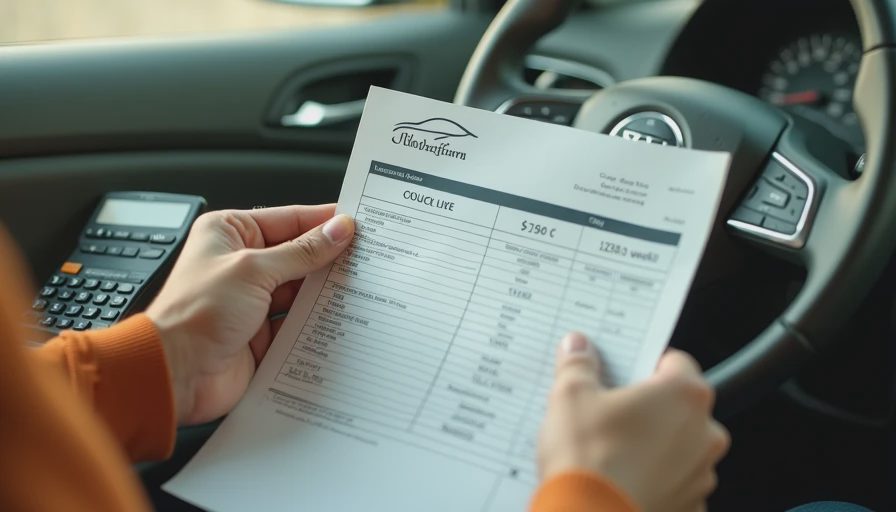
Call or email three dealers and use the same sentence: “Please send me the total out the door price for this stock number, including taxes, fees, and any dealer-installed products.” Give them the exact vehicle identification number or stock number. A quote for “a similar model” is not useful when equipment and incentives differ.
The total out the door price should arrive as a written buyer’s order, worksheet, or itemized quote. A salesperson who says, “Come in and we can talk numbers,” has not given you a quote. You can still visit, but you should know that the conversation is being moved from a clear comparison to a showroom negotiation.
Look for differences between quotes. Dealer A might show a $26,500 selling price and $1,200 documentation fee. Dealer B might show $26,900 and a $399 fee. Dealer B is only $-? Do the complete math instead of reacting to the first large number. In this example, Dealer A is $27,700 before tax and Dealer B is $27,299 before tax, so the second dealer is cheaper despite the higher advertised price.
That is why the total out the door price matters more than a banner discount. A dealer can advertise $3,000 off and recover much of it with a $1,995 add-on package and a $1,000 market adjustment.
Fees you can question without arguing
Government fees are usually the least flexible part of the worksheet. Sales tax, state registration, title charges, and required filing costs generally belong in the transaction. The dealer does not pocket all of those dollars. Ask for the agency or category connected to each charge, then move on.
Dealer fees are different. A documentation fee compensates the store for preparing paperwork, but the amount varies widely. Some states cap it, while others allow more variation. A dealer may not remove the fee from your worksheet, but you can negotiate the vehicle price to offset it. If the documentation charge is $899, ask for an $899 reduction in the selling price.
Watch for vague labels such as “dealer services,” “market adjustment,” “protection package,” or “administrative fee.” Those words do not explain what you receive. A $695 theft deterrent package might be a few stickers and an etched window number. The product is not automatically worthless, but the price deserves a direct question.
When I sold cars, we trained new people to discuss the payment first because $42 every two weeks sounded smaller than $1,092 added to the deal. You do not need to accuse anyone. Just point to the line and ask, “What is this, who receives this money, and can I decline it?”

Do not confuse cash price with financed cost
The total out the door price excludes the interest you pay over time. That distinction matters. Suppose the vehicle and all purchase charges total $28,400. You put down $4,000 and finance $24,400 at 8 percent for 60 months. Your payment will be roughly $494, and the loan will cost more than $29,000 before any insurance or maintenance. The car still has a $28,400 cash price; the loan has a separate finance cost.
A finance manager may lower the payment by extending the term to 72 or 84 months. That can reduce the monthly number while increasing total interest and keeping you upside down longer. Ask for the amount financed, annual percentage rate, term, payment, and total of payments. Those five figures tell you more than “Can you get me under $500?”
Also separate your trade-in from the vehicle price. If your old car is worth $12,000 and you owe $14,000, the $2,000 shortage may be added to the new loan. The total out the door price of the new car has not changed, but your amount financed has grown. That is how a $28,400 purchase turns into a $30,400 loan before interest.
A clean worksheet you can build at home
Use a sheet of paper with six lines. Write the agreed vehicle price first. Add dealer fees next. Add sales tax, title, and registration after that. Put optional products on a separate section, not mixed into the car price. Finally, subtract your down payment and eligible trade equity to estimate the amount financed.
For a $22,400 vehicle, the math might read: $22,400 selling price, $650 documentation fee, $1,480 tax, and $185 title and registration. The total out the door price is $24,715 before a warranty or down payment. If you choose a $1,100 service contract, the purchase total becomes $25,815. That is a choice you can evaluate, not a mysterious increase.
Bring the worksheet to the dealership on your phone. If their number is different, compare each line rather than starting over. A $300 difference could be registration. A $1,500 difference needs an explanation. If the answer is “that is just how we do it,” you have enough information to leave.
What to say when the numbers change
Use plain words. “I am buying based on the written total out the door price. Please correct the contract or explain the difference.” Then stop talking. Silence is useful here. You are not being difficult by asking for the same number you were quoted.
If a product appears that you did not request, say, “Remove that item and show me the revised total.” If the dealership says it is already installed, ask whether the selling price can be reduced by the product amount. If it cannot, compare another vehicle or another store. A floor mat package is not worth turning a $400 disagreement into a five-year loan.
Before signing, check the vehicle identification number, selling price, trade allowance, payoff amount, fees, tax, down payment, interest rate, and amount financed. The total out the door price should match the figure you agreed to, apart from a clearly explained correction.
I told you what they told me to say. Now you know. Next time you shop, ask for the total out the door price in writing before you drive to the lot, and do not sign until every extra dollar has a name.





No letters yet — pray write the first.