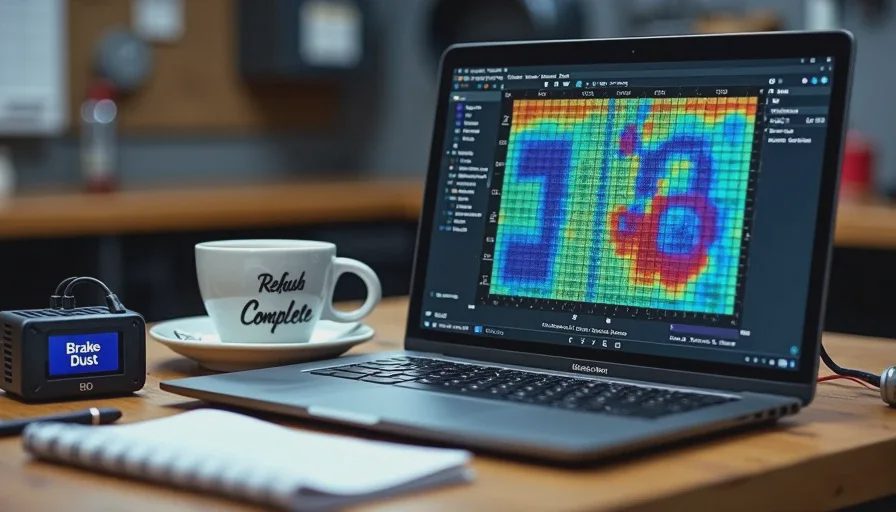
I put off getting a custom ECU tune for my Mk7.5 GTI for two years. Two years of telling myself the off-the-shelf map was “good enough.” Two years of ignoring the occasional hesitation at 3,200 RPM under partial throttle. Two years of convincing myself that a custom ECU tune was something you got after the downpipe, the intercooler, the whole supporting cast — not before.
I was wrong. And I have the dyno sheets to prove it.
This is the story of how a 64-year-old man in a Hoover strip mall changed my mind with five words and a laptop, and why I'm now convinced that a custom ECU tune vs OTS tune is not a “later” decision. It's a “first” decision.
What “OTS” Actually Means
For anyone new to this: an OTS tune — “off-the-shelf” — is a pre-written engine calibration file sold by companies like Cobb, APR, or Integrated Engineering. You buy an Accessport or a flash tool, plug it into your OBD2 port, pick the map that matches your mods, and flash it. Fifteen minutes, and it feels transformative. More boost. More timing. More power. Your butt dyno registers a solid 7 out of 10 on the “this was worth the money” scale.
The problem? An OTS map was written for a GTI, not your GTI. It was developed on a test car in a different climate, probably at a different altitude, with different fuel quality, and almost certainly with a different combination of parts. It's a one-size-fits-most solution, and “most” does not mean “you.”
Here's what I noticed with my Cobb Stage 1 93-octane OTS map over roughly 18,000 miles of daily driving and the occasional track session:
Part-throttle surge at highway speeds. Cruising at 70 mph with the cruise control on, the car would occasionally lurch forward like it suddenly remembered it was turbocharged. Jenn asked if something was wrong with the transmission. I said no. I was not entirely sure.
Knock retard on hot days. Alabama summer means 95°F and humidity you can chew. On three separate occasions, my Accessport logged knock correction pulling 3 to 4 degrees of timing under WOT. That's the ECU saying “I'm about to do something stupid, please stop me.”
Idle hunting after cold start. Not dramatic. Just enough to make the tach needle dance between 700 and 900 RPM for the first 30 seconds. Max, from the back seat: “Why is the car shivering?”
None of these were catastrophic. The car ran. It made power. But if you notice things — and if you're reading a blog about ECU tuning, you do — they start to wear on you.
The Dyno Day That Changed My Mind
Last November, I finally booked a dyno session at a shop in Pelham with a Mustang dyno and an owner who didn't mind me logging data for an hour. I did three pulls with the Cobb OTS Stage 1 93-octane map. Then I drove 12 minutes down Highway 31 to Reg's shop — Reggie Harmon, 64, former engine builder for a NASCAR Busch Series team, currently running a one-man ECU tuning operation out of a strip mall between a vape shop and a dry cleaner.
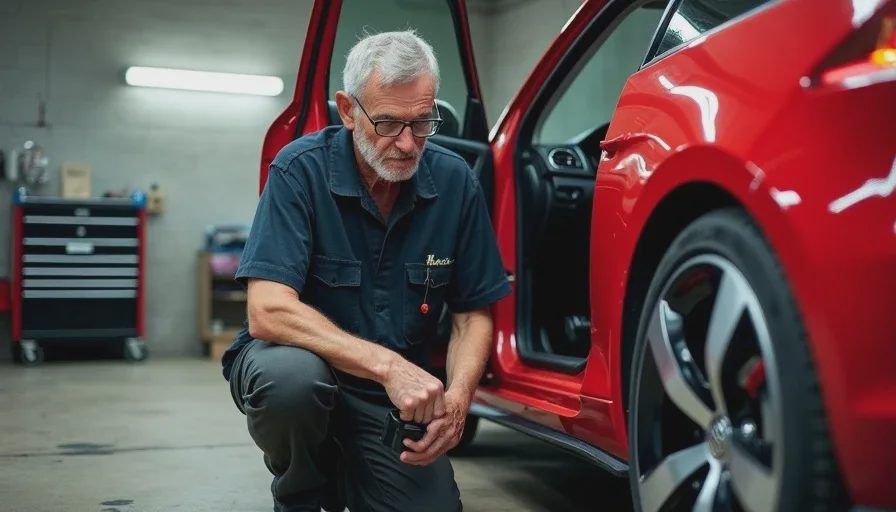
Reg plugged his laptop into my OBD2 port and said, without looking up: “Your fuel trims are compensating.”
I said: “Is that bad?”
He said: “It's not good, Matthew.”
Reg uses your full name when he's about to deliver bad news, like a doctor telling you your cholesterol is high.
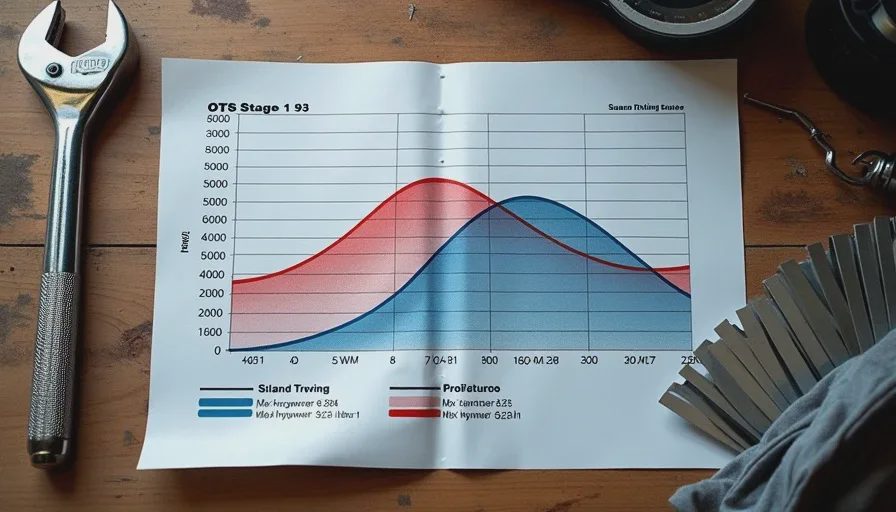
We spent the next three hours going through the data log. Here's a simplified version of what Reg found:
What the OTS Map Was Doing
Parameter | OTS Map (93 Oct) | Issue |
|---|---|---|
Peak boost | 22.3 psi | Targeting too high for pump gas in this heat |
AFR at WOT | 11.8 → 10.2 (rich dip at 5,200 RPM) | ECU dumping fuel to protect against knock |
Timing advance | 8° peak, inconsistent | Pulling timing due to detected knock events |
LTFT (long-term fuel trim) | +7% to +9% | ECU constantly adding fuel to compensate |
In plain English: the OTS map was asking for boost and timing numbers the car couldn't safely deliver on Alabama 93-octane pump gas in 80-degree weather. The ECU was doing its job — protecting the engine — but the result was an inconsistent, rich-running mess that made less power than it should have and left power on the table everywhere above 5,000 RPM.
What Reg's Custom Tune Delivered
Reg didn't chase a peak horsepower number. He started with part-throttle drivability, cleaned up the fuel map at cruising RPMs, then worked upward. Three revisions later:
Parameter | Custom Tune (93 Oct) | Change |
|---|---|---|
Peak boost | 20.1 psi | Lower, but held flatter across RPM range |
AFR at WOT | 11.9 → 11.7 (smooth) | Consistent fueling, no rich dip |
Timing advance | 12° peak, consistent | 4° gained, held through redline |
LTFT | -2% to +1% | Essentially zero compensation |
Final dyno numbers: the OTS map made 281 hp and 317 lb-ft at the wheels. Reg's custom tune made 294 hp and 326 lb-ft. That's a gain of 13 horsepower and 9 lb-ft of torque — but honestly, the peak numbers are the least interesting part of this story.
The real difference is the shape of the curve. Reg's tune holds torque longer through the midrange and doesn't fall off a cliff after 5,500 RPM like the OTS map did. The part-throttle surging is gone. The idle is steady. On my first drive home, I sat at a stoplight on Lakeshore Drive and the car just... idled. Like a normal car. I hadn't realized how much I'd normalized the little imperfections.
What This Actually Cost
Let's talk dollars, because that's what I'd want to know if I were reading this:
Item | Cost |
|---|---|
Cobb Accessport (already owned) | $675 (sunk cost) |
Dyno time (1 hour, 3 baseline pulls) | $120 |
Reg's custom tune (street + dyno, 3 revisions) | $450 |
Post-tune dyno verification (30 min) | $60 |
Total (not counting Accessport) | $630 |
For comparison: an APR Stage 1 flash at a dealer runs about $500 to $600, and it's still an off-the-shelf calibration — just one that you can't modify or data-log yourself. If you're already in the Cobb ecosystem, the jump from OTS to custom is not a huge additional investment. And if you're starting from scratch, I'd argue you should budget for a custom tune from day one and skip the OTS step entirely.
One Thing I Wish I'd Known
Reg told me something during that tuning session that I've thought about at least once a week since. I was staring at the laptop screen, watching him adjust cells in a fuel map I barely understood, and I said something about how complicated it all looked.
He didn't look up. Just said: “Air-fuel ratios don't care about your feelings.”
Then he saved the file, unplugged the laptop, and said the car was ready.
What I wish I'd known two years ago is this: an OTS tune is a starting point, not a destination. It's the ECU equivalent of buying a suit off the rack and hoping the sleeves are the right length. Sometimes they are. Usually they're close enough that nobody notices. But if you're going to live with the car — really live with it, commute in it, put your kids in it, take it to the track — the difference between “close enough” and “right” is noticeable every single day.
That $630 bought me a car that doesn't surge on the highway, doesn't pull timing in August, and doesn't make my five-year-old ask why it's shivering. I'm not going to tell you that's cheap. But I will tell you it was worth it.
Have you made the switch from OTS to custom? What did you notice — and what did you wish you'd done sooner? I'm genuinely curious, because I suspect my two-year delay is not unusual. Reply and tell me your tuning story.

No letters yet — pray write the first.