
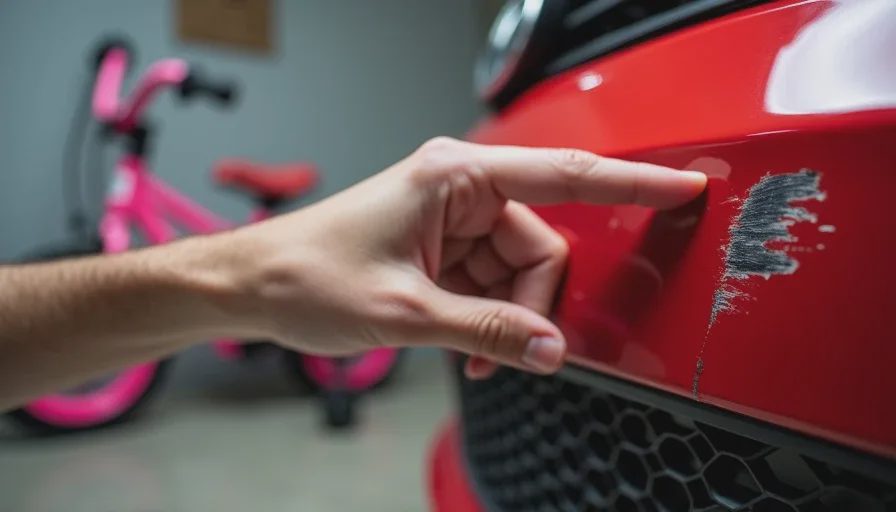
The scratch on my GTI's front bumper is exactly seven inches long. It arcs from just below the passenger-side headlight to the middle of the grille, a shallow gouge through the clear coat and into the paint, with a small chip missing at the deepest point. It's been there for fourteen months. I have not fixed it. I have not gotten a quote. I have not watched a YouTube tutorial about touch-up paint and thought "I could do that on a Saturday." The scratch is staying. Here's why.
This is a story about a sporty car with a car seat — specifically, a red Mk7.5 GTI that serves double duty as my daily driver and my daughter's ride to soccer practice. But it's really a story about what happens when the two halves of your life collide in the driveway on a Saturday morning, and which one you choose to preserve.
The Day It Happened
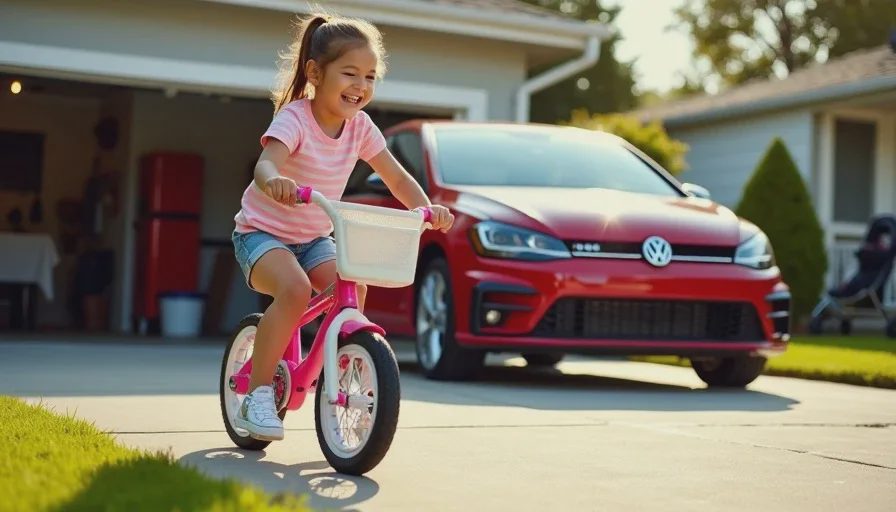
It was a Saturday morning in October. Jenn was at a teacher training workshop. Max was inside watching something involving animated dinosaurs, which meant I had approximately 22 minutes of one-on-one time with Lily. She'd been asking me to take her training wheels off for weeks. Every time we walked past the garage, she'd look at her pink bike — a birthday gift from my parents, complete with a white basket and a bell she rang constantly — and say, "Daddy, I'm ready."
I was not ready. Not for her to ride without training wheels, and not for what happened next.
I removed the training wheels with a 10mm wrench. We walked the bike to the top of the driveway. I gave her the standard dad speech about balance, about looking where you want to go, about not panicking. She nodded seriously. I held the back of the seat. She started pedaling. I jogged alongside her, one hand on the saddle, and then — because she was balanced, because she was ready, because I had underestimated her — I let go.
She rode ten feet. Then fifteen. Then she realized I wasn't holding on, looked back over her shoulder, and the bike veered right. Straight toward my car.
I want to pause here and tell you that I saw it happening in slow motion. I didn't. It happened fast — the handlebar turning, the bike tipping, Lily putting her foot down and catching herself before she fell, the metal edge of the handlebar scraping along the GTI's front bumper with a sound like a zipper closing. She didn't crash. She didn't cry. She stood there, one foot on the ground, looking at the scratch on my car, and said: "I think your car is fine, Daddy, but can we try again?"
We tried again. She made it to the end of the driveway. Then to the mailbox. By the time Jenn came home, Lily was doing laps around the cul-de-sac with no training wheels, and I had a seven-inch scratch on my car that I hadn't mentioned yet.
Why I Didn't Fix It
For the first week, I told myself I'd get it fixed. I looked up touch-up paint codes. I watched a video from a detailer who made scratch repair look like meditation. I mentioned it to Reg, who said — and I'm paraphrasing — that a car without scratches is a car that hasn't done anything interesting.
But the real reason I didn't fix it has nothing to do with cost or laziness. The scratch is a timestamp. Every time I walk past the front of the GTI in the Home Depot parking lot, I see it and remember that morning. I remember Lily's face when she realized she was riding on her own. I remember her saying "can we try again" instead of crying. I remember that she trusted me to let go, and I did, and it worked.
The scratch is the most visible reminder I have that my car is not a showpiece. It's a family car that goes to the track. It's a sporty car with a car seat in the back and a handlebar-shaped scar on the front. Those two things are not in tension. They're the whole point.
The Other Scratches I've Already Fixed
To be fair, I haven't left every mark on this car untouched. Here's a quick inventory of damage I've repaired over four years of ownership:
Damage | Cause | Fixed? | Cost |
|---|---|---|---|
Rock chip, hood | Highway debris | Yes — touch-up paint | $22 |
Door ding, driver's side | Unknown parking lot | Yes — PDR | $75 |
Scrape, passenger side skirt | Curb at the track | Yes — sanded and repainted | $180 |
Scratch, front bumper | Lily's bike | No | $0 |
The rock chip was meaningless. The door ding was annoying. The curb scrape was my own fault and I fixed it because it bothered me. The bike scratch? I've had fourteen months to fix it, and I haven't. At some point, inaction becomes a decision. This is a decision.
What the Scratch Represents
I have a theory about car enthusiasts and damage. We divide the world into "before" and "after" — before the first scratch and after it. Before, you park at the far end of the lot. You check the car for door dings every time you come out of the grocery store. You feel a little spike of anxiety whenever someone walks too close to the fender with a shopping cart.
After, you still care. You still wash the car and keep up with maintenance and wince when a rock hits the windshield on the highway. But the car stops being a thing you're preserving and becomes a thing you're using. The scratches become part of the car's story. And stories, unlike paint, don't need to be buffed out.
I asked Lily recently if she remembered scratching my car. She's seven now, old enough to understand that cars cost money and scratches are not ideal. She said yes, she remembered. Then she said: "But you weren't mad."
I wasn't. I'm still not. That's the part that surprised me.
The Dad Car Tax
There's a phrase that gets thrown around in car forums: the "dad car tax." It usually refers to the performance compromises you accept when you buy a practical family vehicle instead of a two-seater. But I think the real dad car tax is the scratches. The Cheerios ground into the back seat. The mystery stain on the passenger-side floor mat. The handlebar-shaped gouge on the front bumper that you could fix but choose not to.
If you're shopping for a sporty car with a car seat, you're going to pay this tax. Not in dollars — in evidence. Your car will show signs of the life it's been part of. This is not a design flaw. It's not something to be avoided. It's the point of buying a car you can live with instead of a car you have to protect from your own family.
When the Car Becomes Part of the Story
I've spent a lot of time on this blog talking about lap times and suspension setups and ECU tuning — the measurable, quantifiable, spreadsheeted side of car enthusiasm. This post is about the other side. The side that doesn't fit in a data log.
A car that's never been scratched is a car that's never had a kid learn to ride a bike next to it. A car that's never had Cheerios in the back seat is a car that's never driven a five-year-old to preschool. A car that's never been dirty is a car that's never been anywhere interesting.
I'm not saying you should stop caring about your car. I'm saying the car should be part of your life, not something your life has to work around.
Last weekend, I was washing the GTI in the driveway. Lily came out and looked at the scratch. She traced it with her finger and said, "That's where my bike hit it." I said, "I know." She said, "Are you going to fix it?" I said, "No." She thought about this for a moment, then picked up the hose and started spraying the wheels.
She's learning that cars are things you take care of, not things you keep perfect. That's a better lesson than anything I could teach her about touch-up paint.
The Scratch Stays
I might fix it someday. When the GTI is ten years old and has enough other imperfections that this one doesn't stand out. Or when Lily is old enough to drive and I hand her the keys to a car she once left a mark on. That would be a good moment to buff it out — not because the scratch is ugly, but because the story has come full circle.
Until then, the scratch stays. It's the first mark on this car that I chose not to erase. It won't be the last.
What's the scratch or dent on your car that tells a story? The one you could have fixed but didn't? Reply and tell me. I'm collecting evidence that the best cars are the ones with the most stories, not the fewest scratches.



No letters yet — pray write the first.