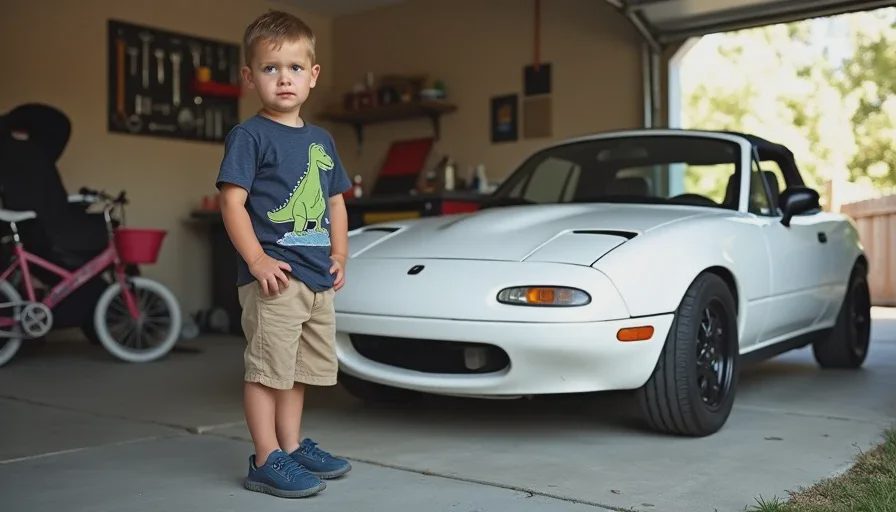
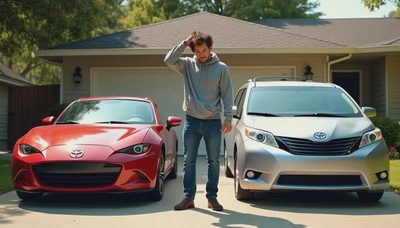
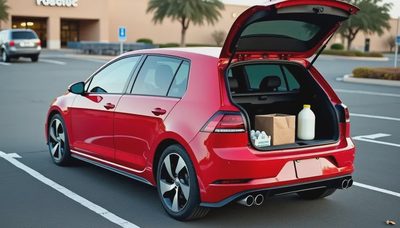
My five-year-old son Max has a theory about my car. He's had it for roughly two years — which is to say, for as long as he's been able to form coherent opinions about the world. The theory, delivered from his car seat in the back of the GTI while the Miata idles in the garage next to us, goes like this:
"Daddy's broken car doesn't have a roof. It doesn't have a radio. It shakes when it's standing still. It's broken."
He's not wrong. He's five, and his entire framework for "car" is built on the Sienna and the GTI — vehicles with roofs, radios, and idle characteristics that don't make your teeth chatter. By every metric available to a kindergartner, the Miata is broken. And I've spent the better part of two years trying to explain why it's not, which has forced me to confront something I didn't expect: I'm not sure I have a good answer.
This is a story about teaching kids about manual transmission — sort of. It's really a story about what happens when a five-year-old asks you why your car is the way it is, and you realize halfway through your answer that you're no longer talking about cars.
The First Question: "Why Doesn't It Have a Roof?"
This was the first question Max ever asked about the Miata, back when he was three. We were in the garage, and I was checking the oil before a track day. He pointed at the Miata and said, "Where's the roof?"
"It doesn't have one right now," I said. "The roof is folded up behind the seats. It comes out when it rains."
"Why?"
"Because driving without a roof is fun. You can feel the wind and see the sky."
He considered this for a moment. "The Sienna has a roof."
"The Sienna does have a roof."
"The Sienna is not broken."
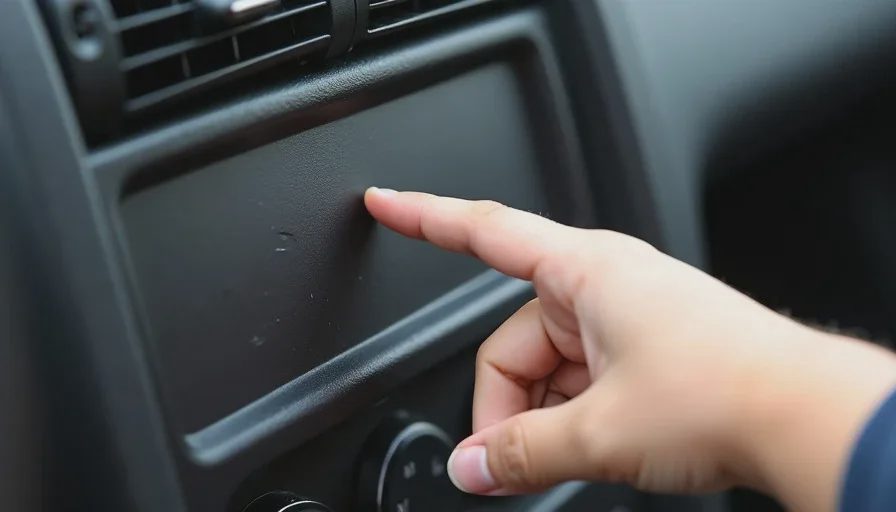
This is the logic of a three-year-old. The Sienna, with its automatic sliding doors and its DVD player and its three rows of seating, is the platonic ideal of a car. It does everything a car is supposed to do. It keeps you dry. It plays music. It doesn't shake. The Miata, by contrast, fails at every basic car function Max can identify. It doesn't keep you dry. It doesn't play music — the radio was removed three winters ago to save weight, and the hole in the dash is now occupied by a blanking plate. It shakes at idle like a washing machine with an unbalanced load.
I tried to explain the concept of a convertible to a three-year-old. I talked about fresh air and sunshine and the feeling of being connected to the road. He listened politely and then said, "Can we go inside? I want a granola bar."
The conversation was over. But the question has lingered in my mind for two years. Why doesn't the Miata have a roof? Not in the literal sense — I know where the soft top is — but in the larger sense. Why do I choose to drive a car that's missing things that every other car in our driveway has? What am I trying to prove?
The honest answer, the one I can't give a five-year-old, is that I like the absence. I like that the Miata doesn't have the things the Sienna has, because the Sienna already exists. The Sienna is there for the rainy days and the grocery runs and the family road trips. The Miata is there for the other days — the ones where I'm alone in the car, and the sky is clear, and the 19-minute drive to the track feels like the only 19 minutes of the day that belong entirely to me.
That's too much to explain to a five-year-old. So instead, when Max asks why the Miata doesn't have a roof, I say: "Because it's a race car, buddy."
He accepts this. It's not the whole truth, but it's the part he can understand.
The Second Question: "Why Doesn't It Have a Radio?"
This question came about six months later. Max was sitting in the Miata's passenger seat — the car was off, parked in the garage — pretending to drive. He was turning the steering wheel and making engine noises with his mouth, the way kids do. Then he reached for the center console, where the radio should be, and his hand found the blanking plate.
"Daddy, where's the music?"
"There's no radio, buddy."
"Why?"
"Because I took it out."
"Why?"
This is the question behind every question a five-year-old asks. Why. Why. Why. It's an interrogation method that would be banned by the Geneva Convention if five-year-olds were a signatory power. And every why forces you to go one layer deeper, past the surface-level answer and into the thing you actually believe.
Layer one: I took the radio out to save weight. The stock radio and speakers weighed about twelve pounds. Removing them is free, and twelve pounds is twelve pounds.
Layer two: I don't miss the radio because the Miata makes its own music. The engine note changes with RPM in a way that rewards attention. At 4,000 RPM, there's a growl from the intake. At 6,000 RPM, the exhaust note sharpens into something urgent. At 7,000 RPM — redline — the engine is shouting at you, and if you're listening properly, you don't want anything else in your ears.
Layer three: I took the radio out because I wanted to hear the car more clearly. Not just the engine — the tires, the suspension, the wind. A car with no radio is a car that's always talking to you. Every squeak, every rattle, every change in pitch is a piece of information. The Miata without a radio is a more honest car. It can't hide anything.
None of these layers work on a four-year-old. So I said: "The car likes to sing its own songs."
Max thought about this. "Can it sing the dinosaur song?"
"No, buddy. It can't sing the dinosaur song."
He looked disappointed. He climbed out of the passenger seat and went inside. The Miata sat in the garage, silent, no radio, no dinosaur song, just the faint tick-tick-tick of the engine cooling down.
The Third Question: "Why Is It Shivering?"
This was the hardest question. It was a cold morning in January. I'd started the Miata to move it out of the garage so I could get to the snowblower — a tool I use approximately once every three years, but which Jenn insists we keep. The Miata's idle was rough. The tach needle was bouncing between 800 and 1,100 RPM, the engine rocking slightly on its mounts, the whole car vibrating in a way that made the steering wheel tremble.
Max was standing in the doorway to the kitchen, watching. "Daddy, your car is shivering."
"It's just cold, buddy. Cars do that."
"The Sienna doesn't shiver."
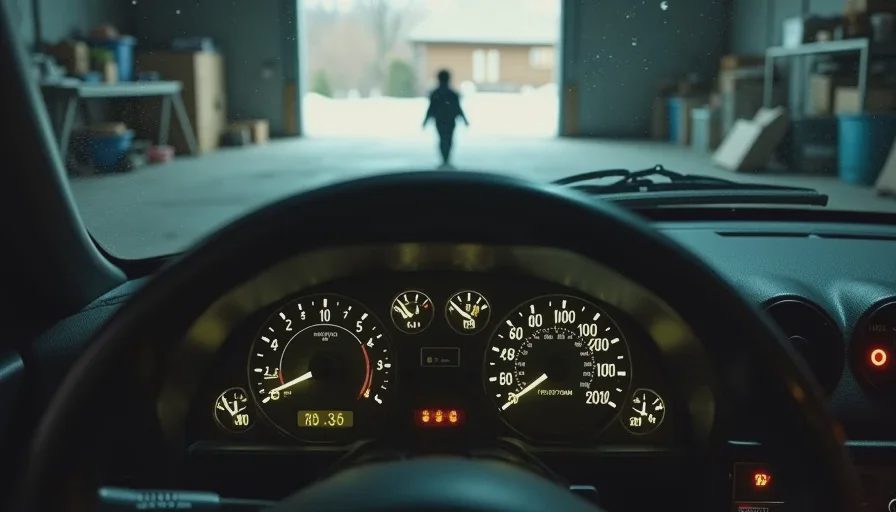
This again. The Sienna, with its fuel-injected V6 and its electronic idle control and its general refusal to be interesting in any way, starts up on a cold morning and idles like a sewing machine. The Miata, with its 30-year-old idle air control valve that I've since replaced but which was, at that moment, still lying to the ECU, idled like a car that was actively trying to shake itself apart.
I told him the truth, or a version of it. "The Miata is old. Sometimes old things shake a little when they're cold."
"Like Grandpa?"
My father-in-law has a tremor in his left hand. Max noticed it at Christmas. I had not prepared for this connection.
"Yes, buddy. Kind of like Grandpa."
Max nodded. He seemed satisfied with this answer. He went back inside. I stood in the cold garage, one hand on the Miata's fender, feeling the vibration through my palm, and thought about how close he'd gotten to the truth without knowing it.
What Max Is Actually Asking
Here's what I've realized, after two years of these conversations: Max isn't asking about the car. He's asking about me.
"Why doesn't your car have a roof?" means "Why are you different from the other dads?" "Why doesn't it have a radio?" means "Why do you choose this thing that makes no sense?" "Why is it shivering?" means "Why do you keep something that's clearly not working right?"
These are fair questions. They're the same questions I'd be asking myself, if I were five years old and my dad spent every Saturday morning in the garage with a car that seemed perpetually broken. Max is trying to build a model of the world, and the Miata doesn't fit into it. Cars have roofs. Cars have radios. Cars don't shake. The Miata violates all three rules. The only possible conclusion, within his framework, is that the car is broken.
But there's another framework, one he can't see yet, where the things the Miata is missing are not defects. They're choices. The roof is missing because I want to feel the air. The radio is missing because I want to hear the engine. The shaking is not a malfunction — it's the engine telling me something, and I'm listening.
I don't expect Max to understand this now. He's five. He's still learning that the Sienna and the Miata are both cars, even though they look nothing alike. The idea that a car could be intentionally missing things — that absence could be a feature, not a bug — is probably a few years beyond his cognitive development.
But the conversations matter anyway. Not because of what Max learns from them, but because of what I learn. Every time he asks me why the Miata is the way it is, I have to articulate something I've been feeling but haven't put into words. I have to explain myself. And in explaining myself to a five-year-old, I end up explaining myself to me.
Teaching Max to Shift: The Conversation That's Coming
I've been thinking about when to teach Max how a manual transmission works. He's interested in the gear lever — he likes to sit in the driver's seat and row through the gears with the engine off, making shifting noises with his mouth. He asks what the third pedal is for. He watches my feet when I drive.
Someday, probably sooner than I expect, I'm going to sit him down and explain the relationship between the clutch, the flywheel, the gears, and the wheels. I'm going to tell him about rev-matching and heel-toe downshifting and why you never rest your hand on the shifter. I'm going to teach him to drive a manual transmission, not because he'll need to — by the time he's 16, manual transmissions will be even rarer than they are now — but because understanding how a clutch works is understanding how to connect two things that are moving at different speeds and make them move together.
That's a metaphor for something. I'm not sure what yet. I'll figure it out by the time he's old enough to reach the pedals.
For now, I'll keep answering his questions. "Why doesn't the Miata have a roof?" Because the sky is better than a roof. "Why doesn't it have a radio?" Because the engine is better than a radio. "Why is it shivering?" Because it's old, and old things have stories, and you're learning to listen to them.
And when he asks the question he hasn't asked yet — "Daddy, is the Miata really broken?" — I'll tell him the truth. No, buddy. It's not broken. It's just built for a different purpose than the Sienna. It's built to go fast and make noise and feel like the world is right there, on the other side of the door panel, close enough to touch. It's missing things on purpose. Some of the best things in life are missing things on purpose.
He won't understand all of that. He'll probably ask for a granola bar. But someday, years from now, when he's learning to drive, maybe he'll remember the car that didn't have a roof or a radio, and he'll understand.
And if he doesn't, I'll still have the Miata. Still missing its radio. Still shaking at idle. Still broken, in the way that matters, which is to say: not broken at all.
What's the question your kid asked about your car that you couldn't answer the first time? Reply and tell me. I'm collecting the hard ones — the ones that make you think about what you're doing and why.

No letters yet — pray write the first.