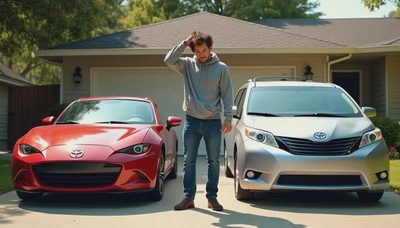
Last Saturday, a young guy pulled into my driveway in a red 1991 Miata with one headlight standing proud and the other one buried in the fender. He had found the car online and thought the seller was asking too much. He was right about the price, but not for the reason he thought. Miata pop up headlights are charming, but they are also an old electrical and mechanical system with a repair bill hiding behind that charm.
The first-generation NA Miata was sold from 1989 through 1997. Its headlights rise from the hood using small motors, plastic gears, relays, switches, and linkages. When everything works, the lights are part of the car's personality. When one stays down, you need to know whether you are looking at a $20 adjustment or a $500 repair. That difference belongs in your purchase math.
Why Miata Pop Up Headlights Fail
Miata pop up headlights usually fail in one of three ways. The motor can run without lifting the assembly, the light can lift slowly or unevenly, or nothing happens when you turn the switch. A stripped plastic gear is common on an older car. So is a worn bushing or a corroded electrical connection, especially on a Miata that has spent years outside.
Here is the driveway test. Turn on the headlights and listen. Both motors should sound similar, and both doors should rise at about the same speed. Turn the lights off and watch them return to the hood. Then use the manual knob on the motor housing to raise and lower each side. Do not force it. If the knob turns endlessly, the internal gear may be damaged. If it feels tight, the linkage could be binding.
A replacement gear kit might cost $20 to $45, and a careful owner can install one with basic tools. A complete used motor may run $75 to $150. New aftermarket assemblies and professional labor can push the repair toward $300 to $600 per side. The seller may call that a minor issue. Your checkbook does not care what the seller calls it.

How to Price a Miata With Headlight Problems
Miata pop up headlights should not be treated as a cosmetic detail when you are negotiating. Start with the car's actual condition. A clean, rust-free NA with a working top, straight body panels, and service records can justify a stronger price than a similar car with water leaks, worn tires, and a dead headlight motor.
Suppose the asking price is $8,500. You find one headlight that needs a gear and notice four old tires at $500 installed. The convertible top has a split seam that could cost $700 to replace. Add a battery at $130 and a professional headlight repair at $350. That is $1,680 before the first oil change. The real purchase is not $8,500. It is $10,180, and that assumes no hidden rust or cooling-system problem.
Make the seller show you the lights working from inside the car. Take a short video of both doors opening and closing. If the seller says the part is cheap, ask why it has not been fixed. Sometimes the answer is honest: the owner has been driving it during daylight. Sometimes the answer is that a cheap part still requires several hours of labor.
The best negotiating language is simple. Say, “The left motor is not completing its cycle. I am pricing $350 for the repair, plus tires and the top. I can buy it today at $6,800.” You are not insulting the car. You are putting the receipt on the hood.
What to Check Beyond the Headlights
Miata pop up headlights get the attention, but rust and neglected maintenance can cost more. Look closely at the rocker panels, wheel arches, floor areas, and the metal around the windshield. Surface rust is one problem. Rust that has reached structural mounting points is a different conversation and can make a cheap car expensive to save.
Open the trunk and lift the carpet. Water often leaves a smell, staining, or damp padding. Check the spare-tire well and the seals around the trunk. Sit in the driver seat and operate the windows, wipers, turn signals, heater fan, and gauges. Electrical problems tend to travel together in neglected cars.
Ask when the timing belt and water pump were replaced. The 1.6-liter and 1.8-liter engines use a timing belt, not a chain. A belt service commonly lands around $700 to $1,200 at a repair shop, depending on parts and labor. If there is no record, treat the service as due rather than assuming the previous owner handled it.
A test drive should include a cold start. Watch for smoke, overheating, a slipping clutch, or a transmission that grinds into second gear. A Miata can feel lively at 35 mph while still needing $2,000 in deferred work.

Insurance and Miata Pop Up Headlights
Miata pop up headlights can affect how you think about insurance, even though a headlight motor failure itself is usually maintenance, not an insured loss. Liability coverage pays for damage or injuries you cause to other people, subject to your policy limits. Collision coverage generally applies when your Miata hits another vehicle or object. Comprehensive coverage is designed for non-collision losses such as theft, hail, falling objects, vandalism, and certain animal strikes.
If a motor simply wears out, you should expect to pay for it yourself. If a storm drops a branch onto the hood and damages the headlight doors, the claim would be evaluated under comprehensive coverage, minus your deductible. If you have a $1,000 comprehensive deductible and the repair is $650, insurance is not going to make that bill disappear.
Older Miatas are often inexpensive to insure because the vehicle value is modest, but rates depend on your driving record, location, mileage, age, and coverage choices. Get a quote before handing over a deposit. Ask for the price with liability only, then compare it with a policy including comprehensive and collision. On a $7,000 car, a high deductible can make full coverage less useful than you expected.
Tell the insurer the correct year, trim, mileage, and use. Do not describe a heavily modified track car as a stock commuter if the changes affect its value. Save receipts for wheels, suspension, paint, and interior work, but understand that standard policies do not automatically reimburse every modification at its full cost.
The Smart Buyer's Final Walkaround
Miata pop up headlights should open, close, and sit evenly before you call the car ready to buy. Bring a flashlight, tire gauge, paper towel, and a phone charger for recording the inspection. Check the VIN against the title and ask for maintenance records. Look underneath for fresh oil, coolant, bent metal, and cheap repairs hiding under fresh undercoating.
Price the car in three columns: asking price, immediate repairs, and deferred repairs. Immediate repairs are the items that affect safety or basic operation. Deferred repairs include an aging top, weak air conditioning, faded paint, and worn seats. This keeps you from arguing about one dramatic issue while missing five smaller bills.
If the car is listed for $9,000 and needs $2,000 right away, it is not a $9,000 bargain. It is a $11,000 project. Sometimes that is still fair for a clean, rust-free example. Sometimes a $6,500 car with working equipment is the better deal.
Before you buy, get an insurance quote, inspect the headlight motors, and have a Miata-friendly shop perform a pre-purchase inspection. Ask the mechanic to write down each repair with a dollar estimate. Then take that paper back to the seller and negotiate from facts. I told you what they told me to say. Now you know. Next time you see those headlights stuck halfway up, do not smile and call it character. Price the motor, price the labor, and make your offer from there.
No letters yet — pray write the first.