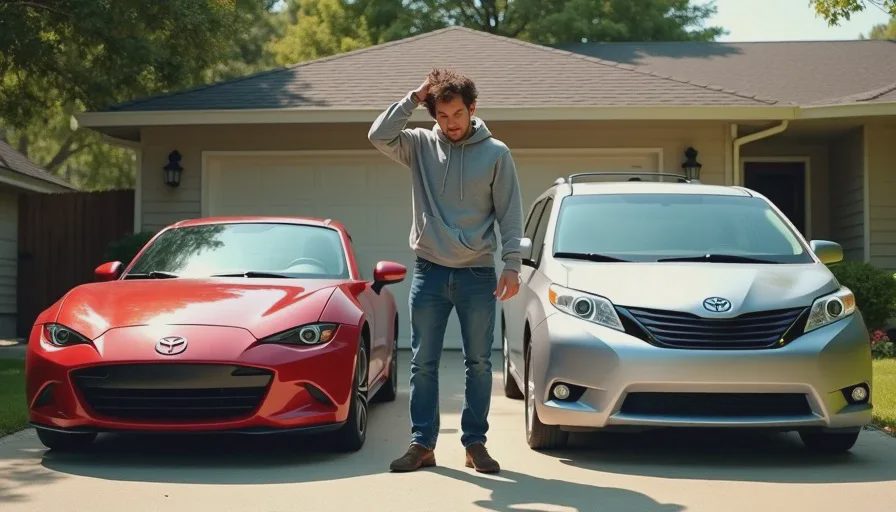
It started, like all questionable late-night decisions, with an Excel spreadsheet. I was updating the Miata’s build log — $24.87 for a replacement PCV valve, $12.50 for yet another can of brake cleaner — when curiosity got the better of me. You know how it goes: one minute you’re logging expenses, the next you’re pulling horsepower specs for your wife’s minivan. That’s when I discovered something deeply unsettling. In a straight line, the Sienna is faster than my Miata. Not just “maybe faster.” On paper, by the numbers, with real manufacturer data and zero excuses, the Sienna will put a fender on me every time. This is a cry for help.
The Spreadsheet Confrontation
I did what any self-respecting car guy with a logistics background would do: I built a comparison table. No emotion, just numbers. The kind of data-driven approach that keeps my day job at Vulcan running smoothly but apparently can’t save my dignity on a Tuesday night.
The Cold, Hard Numbers
Here’s what I plugged in, using published specs from Car and Driver’s instrumented tests for a 2017 Toyota Sienna SE (Jenn’s ride) and my own ’94 Miata with the 1.8L. I’ve weighed the Miata at Barber’s scale with a half tank and no passenger — 2,280 pounds. The Sienna’s curb weight I pulled from the owner’s manual: 4,615 pounds. Math ahead.
Stat | 1994 Mazda Miata (NA) | 2017 Toyota Sienna SE |
|---|---|---|
Engine | 1.8L I4 | 3.5L V6 |
Horsepower | 128 hp @ 6,500 rpm | 296 hp @ 6,600 rpm |
Torque | 110 lb-ft @ 5,000 rpm | 263 lb-ft @ 4,700 rpm |
Curb Weight | 2,280 lbs | 4,615 lbs |
Power-to-Weight | 17.8 lbs/hp | 15.6 lbs/hp |
0–60 mph (C&D tested) | 8.8 seconds | 7.0 seconds |
Quarter Mile | 16.7 sec @ 82 mph | 15.4 sec @ 92 mph |
Look at that power-to-weight ratio. The Sienna, a vehicle designed to haul seven humans and their Costco spoils, carries 2.2 fewer pounds for every pony under the hood. That’s not a rounding error. That’s a gap wide enough to parallel park in.
Why Power-to-Weight Tells the Real Story
People get hung up on peak horsepower, but on the street, it’s all about how many pounds each horse has to drag. The Miata’s 1.8 is a willing little engine — it revs happily and I’ve wrung it out to 7,000 rpm more times than I can count — but it’s hauling a steel-bodied chassis from the early ’90s. The Sienna’s 3.5-liter V6? It’s barely working. Jenn merges onto I-65 with the AC blasting and three kids’ worth of soccer gear, and the thing just squats and goes. In an imaginary stoplight drag, the Sienna would be through the intersection while I’m still looking for second-gear synchro.

The Imaginary Drag Strip at the Stoplight
I’ve replayed this scenario in my head a dozen times. Red light at Lakeshore Drive and Green Springs Highway, the Sienna in the right lane, me in the left with the Miata’s nose pointed uphill just enough to make clutch engagement a thigh workout. Jenn wouldn’t even know we were racing. She’d be adjusting the volume on a Taylor Swift song while the V6 quietly, effortlessly, pulled three car lengths on me before I hit the speed limit.
The worst part? The Miata is loud. I’ve got a Racing Beat cat-back that drones at exactly 3,200 rpm — right where I’d be in second gear, screaming toward 60. The Sienna is silent. Silent and fast. Like a ninja-shaped refrigerator.
Jenn’s Reaction
When I showed Jenn the spreadsheet — I was genuinely troubled, okay? — she glanced at the laptop, took a sip of her coffee, and said, “So the minivan you make fun of could smoke your track car. Got it.” Then she asked me to move the Miata so she could get the recycling bin to the curb.
She didn’t roll her eyes. That would imply effort. She just smiled the smile of someone who’s been putting up with car talk for twelve years and has finally received a gift from the universe.
What This Means for My Track Cred
Here’s where I grasp for context. The Miata wasn’t built for drag racing. It’s a momentum car. Tight corners, Barber’s Turns 2 and 3, the little flick through 14A — that’s where 2,280 pounds and double-wishbone suspension make the Sienna feel like a UPS truck. The Sienna would wash out in a corner before the stability control finished its coffee. I know this. I believe this.
But on the street? On the daily drive to Vulcan’s office or the post-track-day grocery run? The Sienna would gap me, and every kid in the back seat would be too busy watching an iPad to notice. That’s the real gut punch: the Sienna doesn’t even know it’s fast.
Why This Bothers Me More Than a Faster Sports Car
If a Mustang GT pulled on me at a light, I’d shrug. That car was built to go fast in a straight line. But a minivan? A vehicle whose most aggressive trim level is called “SE” and whose primary accessory is a vacuum cleaner? That stings. It stings because I’ve spent three winters, $2,400 in spreadsheets I keep deleting, and countless skinned knuckles making my Miata capable on track — and yet, in the one discipline that requires no skill and happens eight times on my commute, I lose to a people-hauler.
The Bottom Line
I’m not swapping the Miata for a Sienna. But I’ve stopped making minivan jokes. The next time I’m at a red light next to a soccer mom in a Sienna, I’ll keep my eyes forward, my revs low, and my dignity stashed in the glovebox. The numbers don’t lie. The minivan is faster. And if you ever see a silver Sienna with a “My other car is a Miata” sticker, that’s me, borrowing Jenn’s keys and trying to feel something.
Have you ever been humbled by an unlikely vehicle at a stoplight? Drop your story in the comments — I need the company.


No letters yet — pray write the first.