I have never taken a good photo of my Miata. This is not false modesty. I have a folder on my phone called "Miata Pics" that contains 247 images, and roughly 240 of them look like they were taken by someone who heard about cars on the radio once and is trying to describe one to a police sketch artist. The front bumper is chopped off in most of them. The lighting is whatever the fluorescent tubes in my garage provide. The action shots from track days look like the car is parked. I once texted a photo of the Miata to Reg and he replied, "Is it supposed to be that color?" It was white. I had taken a photo of a white car and made it look beige.
So when Nico Reyes — automotive photographer, former CTCC test driver, and the only person I've ever met who can make a minivan look heroic in golden hour — offered to shoot my car, I said yes before he finished the sentence. What he produced, in roughly the time it takes me to check my tire pressures, was the best photo ever taken of a car I own. This is the story of how he did it, and what I learned along the way.
This post is about car photography panning technique — the kind that makes a car doing 45 mph look like it's doing 145. But it's also about something Nico said that I haven't stopped thinking about: "The car isn't ugly. You've just been photographing it wrong."
The Problem: My Car Wasn't Ugly, I Was Just Bad at Showing It
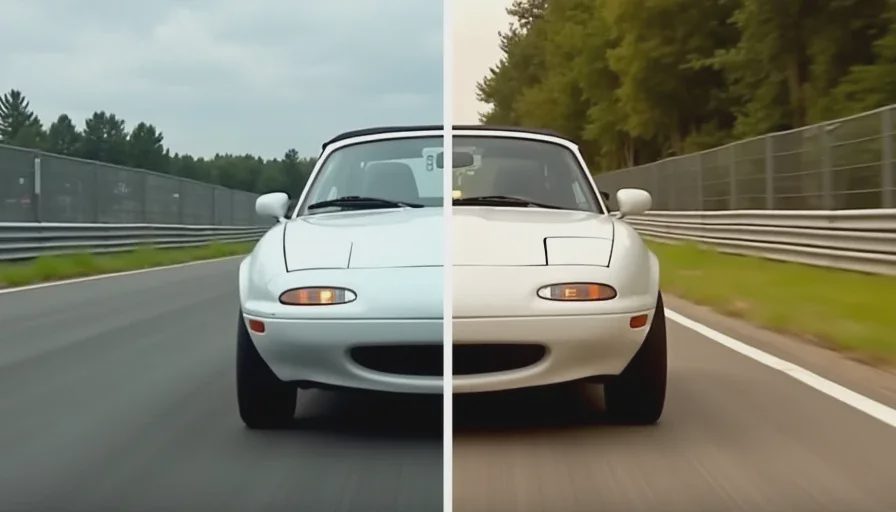
Let me show you my before and after. Not with actual images — you'll have to imagine these — but with descriptions that will be painfully familiar if you've ever tried to take a photo of a car on a track.
Before (my photo): The Miata is a white smudge in the center of the frame. It is in focus, technically, but "in focus" is doing a lot of work here. The background is also in focus — the fence, the porta-potty, the guy in the orange vest eating a sandwich. Everything is equally sharp and equally boring. The car looks like it's parked, because I used a shutter speed of 1/1000th of a second, which freezes everything including the spinning wheels. The Miata, a car I have personally driven at over 100 mph on this exact stretch of track, looks like a die-cast model placed on a diorama. There is no sense of speed. There is no sense of anything.
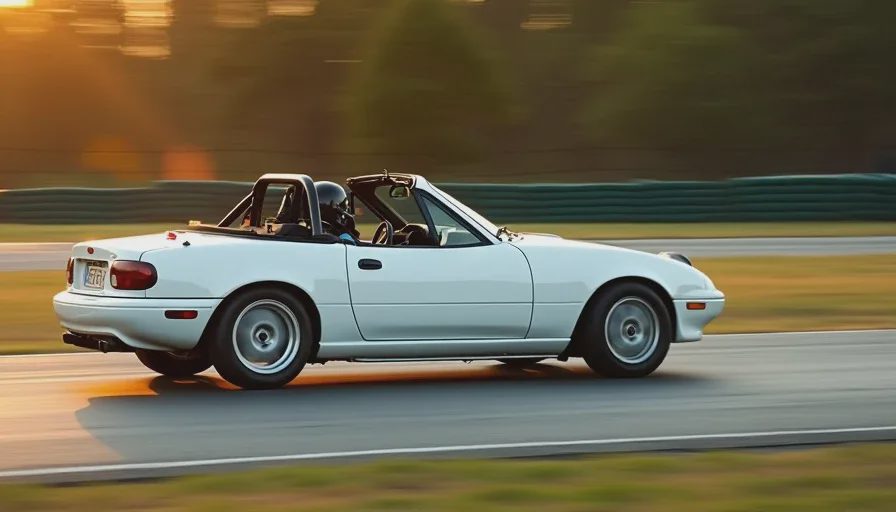
After (Nico's photo): The Miata is razor-sharp in the center of the frame. The background is a wash of gold and green streaks, blurred into abstraction by motion. The wheels are slightly blurred — you can see the spokes, but they're ghosted, spinning. A few blades of grass in the foreground are also blurred, giving the image depth and context. The car looks fast. The car looks alive. The car looks like the car I feel when I'm driving it, not the car that sits in my garage leaking oil onto a piece of cardboard.
The difference between these two photos is technique. But it's also philosophy. Nico doesn't take photos of cars. He takes photos of what cars are doing.
The Lesson: What Nico Taught Me in Forty-Five Minutes
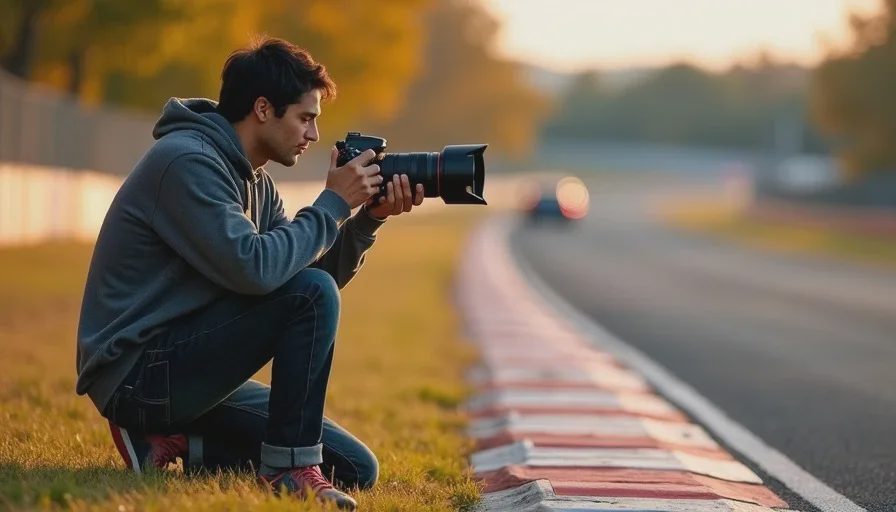
Nico agreed to let me shadow him during a session at Barber. "Don't talk," he said when I showed up. "Just watch. I'll explain after." For forty-five minutes, I crouched next to him in the grass at Turn 5 and watched him work. Here's what I learned.
Shutter Speed Is Everything (And 1/30th Is the Magic Number)
The fundamental technique of panning photography is deceptively simple: you use a slow shutter speed and move the camera to track the car as it passes. The slow shutter creates motion blur in the background. The tracking keeps the car sharp. The result is an image where the subject is frozen but the world around it is streaking past.
The key variable is how slow. Nico shoots most of his track work between 1/30th and 1/60th of a second. For context, the rule of thumb for handheld photography is that your shutter speed should be at least 1 divided by your focal length. With a 200mm lens, that means 1/200th minimum if you want a sharp image. Nico is shooting at 1/30th — six times slower than the "safe" minimum — while tracking a car moving at 80 mph.
"This is why most people fail," he told me later. "They try 1/125th because it's safer. At 1/125th, the background barely blurs. The wheels freeze. The car looks parked. You have to go slow enough that the background commits to being blurry. Half measures don't work."
At 1/30th of a second, with a 200mm lens, tracking a moving car, your hit rate is going to be low. Nico told me he keeps maybe one out of every twenty frames. The other nineteen are slightly soft, or the car isn't perfectly framed, or the background didn't blur the way he wanted. "Digital film is free," he said. "Shoot a hundred frames. Keep three. That's a good day."
Your Body Is the Tripod
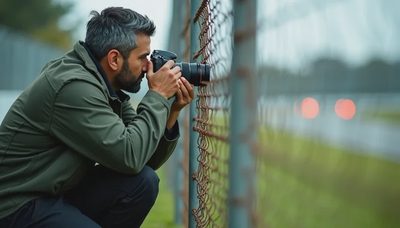
Watching Nico pan is like watching someone practice tai chi. His feet are planted shoulder-width apart. His elbows are tucked into his ribs, not flared out. He rotates from his hips, not his shoulders — his entire upper body moves as one unit, smooth and controlled. The camera isn't being swung; it's being rotated through space.
"Most people track the car with their arms," he said. "Arms are jerky. Hips are smooth. Track with your hips. Let your arms just hold the camera."
I tried this later, in my driveway, panning on passing minivans. It's harder than it sounds. Your instinct is to twist at the waist and fling the camera around. Untraining that instinct takes practice. Nico said it took him two years of shooting every weekend before the motion became natural.
Focus on the Helmet, Not the Car
This was the most counterintuitive thing Nico told me. "Don't focus on the car," he said. "Focus on the driver's helmet. The helmet is inside the car, so if the helmet is sharp, the car is sharp. And the helmet gives you a smaller target to track. It's easier to keep a single point in the frame than an entire vehicle."
I had never thought about this. I had always tried to track the car as a whole — the nose, the windshield, the rear wing — and ended up with images where the car was slightly soft because I couldn't decide which part of it to follow. Nico's approach reduces the problem to its simplest form: pick a point, track the point, trust that the car will come along for the ride.
The Background Matters as Much as the Car
"Bad panning shots happen when the photographer only thinks about the car," Nico said. "Good panning shots happen when the photographer thinks about what's behind the car."
He showed me two images he'd taken of the same Porsche 911 GT3, on the same lap, at the same shutter speed. In the first, the background was a concrete wall — the streaks were gray and uniform and boring. In the second, he'd moved twenty feet down the track so the background was a stand of trees with autumn foliage. The streaks were gold and red and orange, and the image looked like a painting.
"You can't control the car," he said. "You can't control the light. You can control where you stand. Stand somewhere with an interesting background. Stand somewhere the light is good. The car will come to you."
My First Attempt (And Why It Failed)
Armed with Nico's advice, I went to the next Barber track day with my modest DSLR and a rented 70-200mm lens. I set the shutter speed to 1/40th — slightly more conservative than Nico's 1/30th, because I know my limits. I found a spot at Turn 5 with trees behind the track. I planted my feet, tucked my elbows, and picked a car to track.
The first ten frames were a disaster. The car — a blue BRZ — was a blurry smudge in every single one. I was jerking the camera, trying to catch up to the car instead of tracking it smoothly. My hit rate was zero percent. I had somehow made the car look slower than my garage photos.
Then I remembered what Nico said about the helmet. I picked a car — a red E36 M3 — and focused on the driver's helmet. I started tracking before the car entered my frame, rotating from my hips, keeping the helmet centered in the viewfinder. The car passed. I kept tracking after it was gone, following through like a golf swing.
I took twenty frames. One of them was sharp.
One out of twenty. That's a five percent hit rate. Nico would be unimpressed. But the one that worked — the one where the E36 was sharp and the trees were streaks of green and the wheels were blurred — made me feel like I'd just won a trophy. I texted it to Nico. He replied: "Better. Shoot a hundred next time."
The Real Lesson: Photography Changes How You See Cars
Here's the thing Nico taught me that I didn't expect to learn: looking at cars through a camera changes how you see them. When you're trying to capture a car in motion, you start noticing things you'd never see from the driver's seat or the paddock.
You notice how the suspension compresses at the apex. You notice which cars roll and which cars stay flat. You notice the tiny corrections drivers make with the steering wheel. You notice the way light pools in the concave section of a car's bodywork. You notice that every car has a different posture at speed — some hunker down, some lift up, some lean into the corner like they're bracing for impact.
I've driven Barber hundreds of times. I thought I knew what the track looked like. But I'd never really seen it — not the way Nico sees it, crouched in the grass with a telephoto lens, watching the light move across the asphalt, waiting for the moment when a car stops being a car and becomes something else.
"The car is saying something," Nico told me once. "I'm just writing it down."
I used to think this was a metaphor. Now I think it's a job description. The car is communicating — its speed, its balance, its weight transfer, its relationship to the road. The photographer's job is to capture that communication in a single frame. The good ones, like Nico, can do it at 1/30th of a second.
My hit rate is still terrible. My Miata folder now contains roughly 300 images, and most of them are still bad. But mixed in with the blurry ones — the ones where I jerked the camera or missed focus or used a shutter speed that was too fast — there are maybe five that make the car look like what it is. Not a thirty-year-old Mazda with a leaky valve cover gasket and a radio blanking plate. A car in motion. A car with purpose. A car that's saying something, even if I'm still learning to write it down.
If you've never tried panning photography, do it. Rent a lens. Find a track day. Stand somewhere safe and shoot a hundred frames and keep three. You'll learn more about how cars move than any amount of reading ever taught you. And if you're lucky, you'll get one image that looks the way the car feels. That one image is worth the other ninety-nine.
What's the best photo you've ever taken of your car — and what did you learn trying to get it? Reply and share. And if you've got a Nico in your life, buy that person lunch. They're seeing things you're not.
No letters yet — pray write the first.